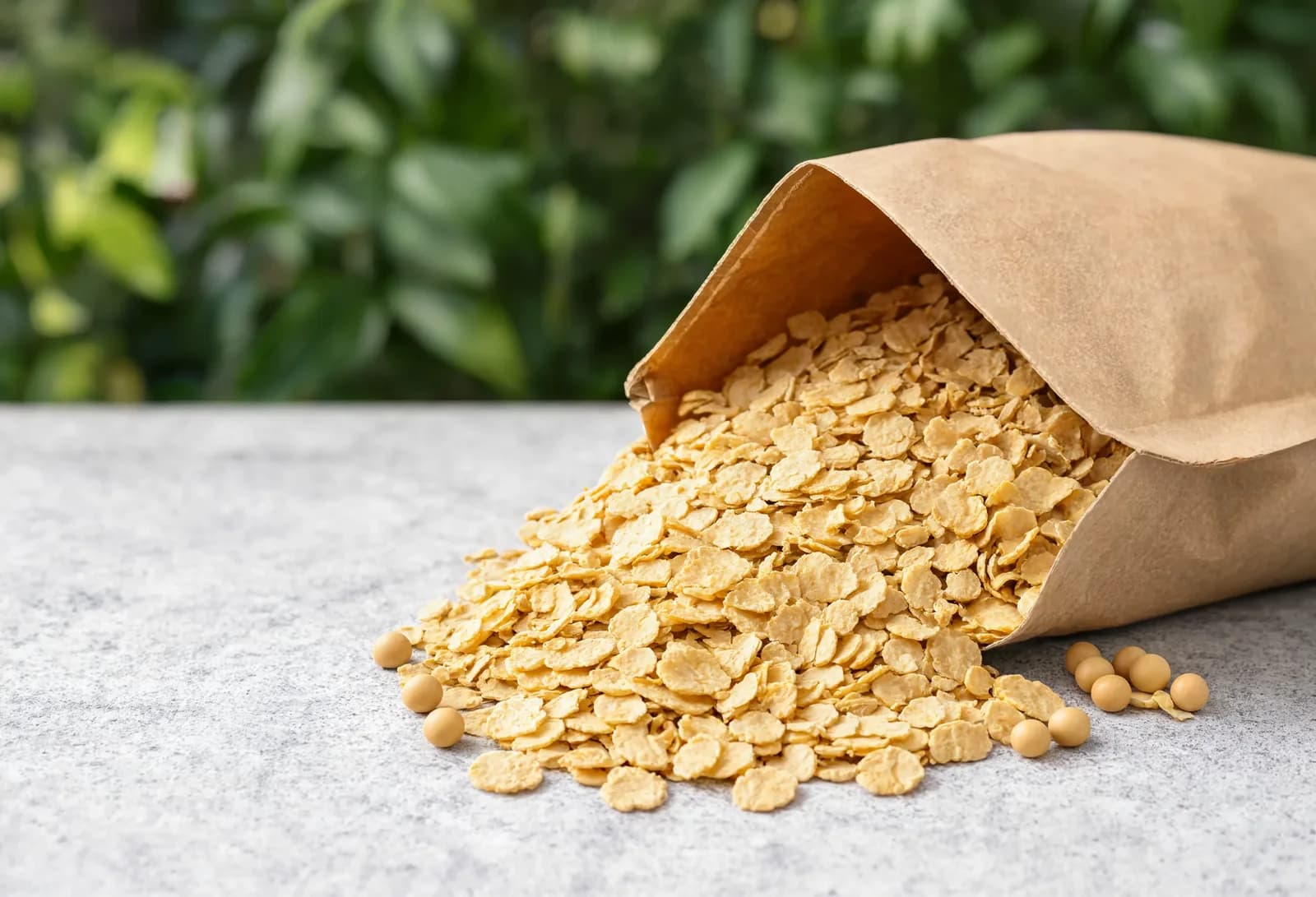
Flaked Full-Fat Soybean
Whole soybeans flaked and heat-processed so that amino acids and concentrated energy come from a single ingredient. Correct heat treatment is the decisive quality issue: underprocessing leaves excessive trypsin inhibitor activity, while overprocessing damages lysine and lowers protein digestibility — quality cannot be judged from crude protein and fat alone. Processing reduces heat-labile antinutritional factors to controlled levels rather than eliminating them. It can replace defined portions of soybean meal plus added oil once the complete diet is recalculated on digestible amino acids, metabolizable energy and total fat, and suits professionally formulated dairy, poultry, small ruminant and selected aquaculture diets — no single inclusion rate carries across species. High unsaturated fat is not an unlimited benefit: oxidation and rumen fat limits apply. Every batch ships with a COA covering trypsin inhibitor activity, protein solubility and oil oxidation status.
Specifications
- Processing
- Flaked and heat-treated — narrow process window
- Process indicators
- Trypsin inhibitor activity + protein solubility — no indicator read alone
- Trial inclusion — ruminants
- Dairy 1.0–2.5 kg/head/day · calf starter 50–120 kg/t · sheep & goat 50–150 kg/t — keep total dietary fat within nutritionist limits
- Trial inclusion — poultry & fish
- Broiler starter 50–100 kg/t · grower & finisher 80–180 kg/t · layers 50–150 kg/t · fish 30–100 kg/t
- Documentation
- COA per batch — TIA, protein solubility, oxidation marker, microbial & mycotoxins
- Packaging
- 25 kg bags / bulk
- Origin
- Confirmed per order
Sample catalog — final SKUs, origins and specifications are confirmed per order.