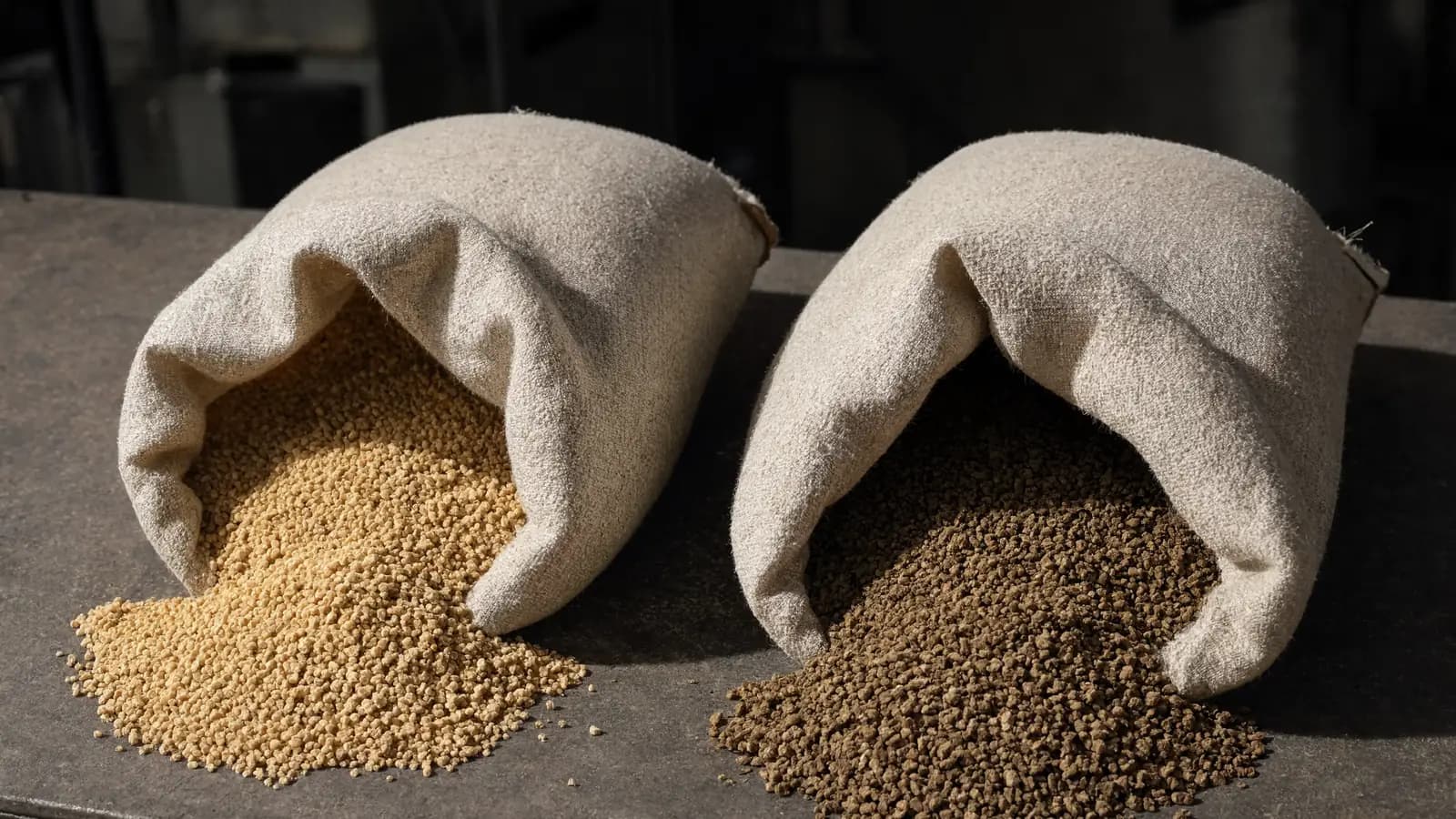
Fishmeal in a broiler starter is one of the last places in commercial poultry where an expensive ingredient survives mostly on reputation. It works — nobody serious disputes that. The question every nutritionist in this region is now being asked by their own procurement department is narrower and harder: how much of it is actually doing work that nothing cheaper can do, and how much of it is there because it has always been there?
Fermented soybean meal is the most credible answer currently on the table, and it is also routinely oversold. This article assumes you already know what fermentation does to soybean meal — if you do not, read our buyer's guide first. What follows is narrower: the broiler starter, the first fourteen days, the fishmeal line in your formulation, and a Gulf poultry house with the evaporative coolers running from March to October. FSBM is a partial replacement. Everything useful in this article follows from taking that word seriously.
Why the first fourteen days decide the cycle
A day-old chick arrives with a digestive tract that is anatomically complete and functionally unfinished. Pancreatic enzyme secretion — protease, amylase, lipase — is still ramping up over the first two weeks. Bile salt production lags. The intestinal villi are still developing surface area. The bird is being asked to digest a dense, high-protein diet with equipment that is, in a real sense, not yet delivered. This is not a metaphor. It is why a starter costs what it costs.
The second half of the argument is the one that actually moves money. Whatever happens to a chick in the first fourteen days does not stay in the first fourteen days. Early bodyweight compounds. A bird that is behind at day 7 is behind at day 35, and the gap has usually widened rather than closed, because a smaller bird eats less, competes worse at the feeder, and spends the rest of the cycle chasing a target it left late. Uniformity behaves the same way: a coefficient of variation set in week one propagates to slaughter, and a wide spread at processing is a direct financial event — grading penalties, more birds outside the target window, a plant that has to work harder for the same yield.
So the starter is the one place in the cycle where an expensive protein can plausibly earn its price. It is roughly six to eight percent of the feed the bird will ever eat. Paying a premium on that fraction is a small number. Paying the same premium on the finisher — where the tonnage lives — is a large one. Hold that ratio in your head; it explains most of what follows.
Why fishmeal is in the starter, and why everyone wants out
The four reasons it earned its place
Be fair to the ingredient before you try to remove it. Fishmeal is in the starter for four reasons, and only three of them are nutritional. First, palatability: chicks eat it, and getting feed into a chick in the first 72 hours is a genuine problem, not a theoretical one. Second, the amino acid profile, which is close to what a growing bird needs and rich in methionine and lysine without heavy reliance on synthetics. Third, digestibility — a well-made fishmeal is highly digestible to an immature gut, and it carries marine lipids and a set of minor components that plant proteins simply do not have. Fourth, and least discussed: habit. It has been in the specification for decades, it works, and nobody gets fired for leaving it in.
The four reasons the industry is trying to leave
- Price volatility. Fishmeal does not move like a feed ingredient; it moves like a commodity with a weather dependency. A single bad season in a major fishing region reprices your starter, and it does so without asking whether you had already sold the birds forward.
- Supply insecurity. Volume is capped by biology, not by demand. Long term, the only direction available is down, and every producer competing with aquaculture for the same tonnage already knows how that auction ends.
- Sourcing scrutiny. Buyers, retailers and increasingly the end customer ask where marine protein came from. That is a question you now have to be able to answer in writing, and answering it well costs money.
- Distance. This one is regional and it is underrated. Most fishmeal reaching a Gulf feed mill has travelled a long way through several hands. Long chains mean lead time, working capital tied up in transit, more opportunity for quality drift in a hot climate, and a substitution risk that only reveals itself when the container is already yours.
None of that makes fishmeal bad. It makes it a concentration of risk sitting in the most sensitive diet you formulate. Reducing that concentration is a reasonable commercial objective on its own, even before you argue about biology.
The realistic position: partial replacement, reformulated properly
Typical trial inclusion of FSBM in a broiler starter sits around 30–60 kg per tonne, displacing an equivalent protein contribution from soybean meal, from part of the fishmeal, or from both. That is the working range, not a specification, and where you land inside it depends on your COA and your bird. Trial work generally supports the direction of travel: an early-life protein that is already partly hydrolysed and carries fewer anti-nutritional factors tends to help exactly the animal whose enzyme secretion is still ramping. It does not support the idea that you can pull the fishmeal line to zero and expect the starter to behave.
Reformulate on digestible amino acids, not crude protein
This is where most attempts quietly fail, and the failure is arithmetic rather than biology. Suppose your starter carries fishmeal at 40 kg/t and you swap in FSBM kilo-for-kilo on a crude protein basis, matching the CP line so the label still reads the same. On paper nothing changed. In the bird, three things did.
- Methionine drops first and hardest. Fishmeal is methionine-rich; soy protein of any kind is not. Match the crude protein and you have silently cut the first limiting amino acid in a broiler starter. The bird does not respond to the protein you declared — it responds to the methionine it absorbed, and you took some away without noticing.
- Lysine drifts, and the ratio drifts with it. Even when total lysine looks acceptable, the digestible lysine and the ideal-protein ratios around it shift. A starter is a balance, not a sum. Move one term and you are no longer feeding the diet you designed.
- Metabolizable energy moves too. Fishmeal brings fat. Take it out and put in a defatted plant protein and the ME of the diet falls unless you add it back — and in a Gulf house in July, where heat is already suppressing intake, a quiet drop in energy density is the last thing you want.
Then the trial reports "FSBM underperformed." It did not. The formulation did. Reformulate the complete diet on digestible amino acids and metabolizable energy, let the optimiser move the synthetic methionine and the added oil to close the gaps, and compare two diets that are nutritionally equivalent on paper. That is the only comparison that tells you anything about the ingredient.
What FSBM replaces, and what it does not
| What fishmeal contributes | Can FSBM cover it? | What you do about it |
|---|---|---|
| Bulk digestible protein | Largely yes — this is the core of the case | Reformulate on digestible amino acids; verify the peptide fraction per batch |
| Low anti-nutritional load for an immature gut | Yes — and this is where FSBM beats plain SBM | Read glycinin, β-conglycinin and TIA on the COA, not the brochure |
| Methionine density | Partly — soy protein is structurally poorer here | Expect the optimiser to add synthetic methionine; budget for it |
| Marine lipids and long-chain fatty acids | No. Not partly. No. | If you were buying fishmeal for this, FSBM is the wrong conversation |
| Chick-specific palatability in the first 72 hours | Not reliably — watch intake, do not assume it | Move in steps, keep a fishmeal residue at first, watch day-7 weight |
| Minor components and the "unidentified growth factor" argument | No — and be suspicious of anyone who says otherwise | This is precisely why the replacement is partial, not total |
Read the fourth row again. It is the one that ends most overambitious projects. If you strip fishmeal out entirely, you also strip out the marine lipid fraction, and no amount of fermented soy puts it back. Partial replacement is not a hedge or a legal disclaimer. It is the actual finding.
What to measure, and when — the part everyone gets wrong
Here is the single most common way a perfectly good FSBM trial produces a useless answer. The farm runs the starter change for fourteen days, then feeds a standard grower and finisher to both arms for another three weeks, then weighs everything at depletion and compares whole-cycle FCR. The difference is small. Somebody writes "no significant effect" in an email and the project dies.
Think about what that number is. Whole-cycle FCR aggregates roughly five weeks of feed intake, of which the intervention touched two. The other three weeks are identical between the arms by design, and they contribute the overwhelming majority of the tonnage. You have taken a real early-life effect and averaged it into silence with three weeks of shared data. The instrument is too blunt for the intervention. That is not a null result — it is a measurement error dressed as one.
Measure inside the window where the effect is supposed to live, and measure the things the ingredient is supposed to move. FCR still matters — but as a late confirmation that you did not break anything, not as the primary endpoint.
| When | Measure | Why it is the right measurement at that moment |
|---|---|---|
| Day 0 | Chick weight, placement count, source flock age | Your baseline. Arms that start apart cannot be compared later — this is where most trials are lost before they begin |
| Days 1–3 | Feed intake, crop fill | The palatability check. If FSBM is going to cost you intake, it happens here and nowhere else |
| Day 7 | Bodyweight and CV% | The earliest honest read. Weigh a real sample, not the birds nearest the door |
| Days 10–14 | Bodyweight, CV%, cumulative mortality | The primary endpoint. This is the window the ingredient was bought for — if there is nothing here, there is nothing |
| Days 7–14, continuous | Litter moisture and friability, scored the same way each time | The oligosaccharide effect shows up here first, and it is cheap to measure |
| Day 35 / depletion | Liveweight, uniformity, footpad scores, FCR | Confirmation, not discovery. Expect the early gap to have narrowed in percentage terms and read it accordingly |
The litter link, and why it matters more here
This is the most under-discussed benefit of FSBM in a broiler starter, and it is mechanistically clean. Soybeans carry stachyose and raffinose — oligosaccharides a chicken has no enzyme for. They pass undigested to the hindgut, where the microflora ferment them, and the by-product is water in the droppings. Fermentation reduces those oligosaccharides substantially. Less substrate reaching the hindgut means less fermentation, means drier droppings, means litter that stays friable instead of capping.
Now put that chain in a closed, evaporative-cooled house in Abu Dhabi or Riyadh in August. Evaporative cooling works by putting water into the air. That is not a design flaw, it is the mechanism — but it means your house runs at a humidity that a temperate-climate producer never has to manage, and the litter is trying to give up moisture into air that is already carrying plenty. Everything that makes litter wetter is amplified here. Capped litter drives footpad dermatitis, footpad lesions are a graded, downgradeable defect at the plant, and ammonia in a tightly sealed house is a respiratory problem before it is a welfare score. A drier dropping in week two is worth more in a Gulf house than the same drier dropping in a naturally ventilated shed in a mild climate. It is a real effect, and it is routinely left out of the business case because nobody puts litter on the invoice.
The Gulf house: what actually changes here
Most of what is written about FSBM in broiler starters was written for a climate and a supply chain that are not yours. Four things are genuinely different in the UAE, Saudi Arabia and the wider GCC, and each one changes the calculation.
- Heat suppresses intake, so density is not optional. A bird under heat load eats less. Every nutrient it needs has to arrive in less feed, which means a starter here is working against a headwind that a European starter is not. That raises the value of highly digestible protein in the window when intake is smallest, and it punishes any reformulation that quietly drops metabolizable energy.
- Humidity makes litter management harder than the textbook assumes. Covered above, and worth repeating because it is the mechanism most likely to show up in your own data before FCR does.
- Your protein is imported, and lead time is a nutritional variable. The GCC imports the overwhelming majority of its feed protein. When a fishmeal shipment slips six weeks, the mill does not stop — it substitutes, and the starter that leaves the plant is not the starter on the spec sheet. A protein you can source regionally, or that is manufactured closer to you, is worth a premium that never appears in a per-tonne comparison.
- Ramadan and Eid pull the whole schedule forward. Demand peaks are not a marketing detail here; they set placement dates. Cycles get compressed, houses get turned around faster, and birds get placed into schedules with less slack than usual. When the calendar is tight, a slow start is not something you can make up later — there is no later. That is precisely when early uniformity stops being a nice number and becomes the thing that determines whether you hit the window.
- Documentation decides whether the ingredient arrives at all. Health certificates, origin declarations and the mycotoxin panel must match the destination authority's current requirements — MOCCAE in the UAE, the relevant national authority elsewhere in the GCC. A batch that is nutritionally ideal and documentarily wrong is a batch sitting at the port while your chicks are already placed.
One practical note on the energy side. Pulling fishmeal out takes fat with it, and in a heat-stressed house you cannot afford to let metabolizable energy sag while intake is already down. The optimiser will usually close that gap with added oil. If you would rather close it with an ingredient that carries protein and native oil together — and keep one line in the formulation instead of two — heat-processed full-fat soybean is the obvious candidate, subject to its own processing caveats and its own COA.
When not to use it
Keep it out of the grower and finisher. This deserves to be blunt, because it is where the money leaks. By day 21 the bird's digestive tract is doing its job. Enzyme secretion has caught up, the villi are developed, and an ordinary well-toasted soybean meal is digested perfectly well. The anti-nutritional factors that justify the fermentation premium are being handled by a gut that no longer needs the help. Put FSBM in a finisher and you are paying a starter-grade premium — across the largest tonnage in the cycle — for a mechanism that has expired.
Two other cases deserve a straight answer. If your starter has no fishmeal and no soy anti-nutritional problem to solve — if it is already running on a well-processed soy programme with a clean COA and your day-7 weights and litter are where you want them — then FSBM is solving a problem you do not have. And if you cannot get a batch-specific COA measuring the peptide fraction, glycinin, β-conglycinin and TIA, do not run the trial at all. You will not be able to interpret it, and an uninterpretable trial is worse than no trial: it produces a conclusion anyway, and the conclusion will be wrong in a direction nobody can predict.
How to run a trial you can actually read
The discipline is simple to state and hard to hold. Change one variable. Not the starter protein and the coccidiostat and the supplier of the maize because procurement got a good price that month. One.
- Make the arms nutritionally equivalent on paper. Same digestible lysine, same digestible methionine, same digestible threonine, same metabolizable energy, same crude fat. Let the optimiser add synthetic amino acids and oil to close the gaps FSBM opens. If the two diets are not equivalent, you are testing your formulation software, not the ingredient.
- Keep a genuine in-house control. Same house, same week, same flock, same chick source, same breeder age. A control from last cycle is not a control — it is a memory, and it differs from your test arm in a dozen ways you did not record. If your house cannot be split cleanly, split by pen and randomise; do not compare house A to house B and call it a trial.
- Fix the inclusion before you start and do not move it. Pick a point in the 30–60 kg/t range, justify it from your COA and your fishmeal line, and hold it. Adjusting mid-trial because week one looked disappointing destroys the only thing the trial had to offer.
- Weigh properly and record the boring things. A real random sample, the same scale, the same time of day, the same person. Log house temperature, relative humidity and litter score alongside the weights — in this climate, the day your coolers underperform will explain more of your variance than the treatment does, and you will only know that if you wrote it down.
- Repeat before you commit. One cycle is an observation. Two cycles in the same house across different seasons is the beginning of a decision. In a market where placement schedules bend around Ramadan, run it once in the compressed season and once outside it before you rewrite the standing formulation.
Frequently asked questions
How much fishmeal can FSBM realistically remove from a broiler starter?
Part of it, not all of it. Typical trial inclusion is 30–60 kg of FSBM per tonne of starter, displacing an equivalent digestible protein contribution from fishmeal, soybean meal, or both. Trial work generally supports partial displacement when the diet is reformulated on digestible amino acids and metabolizable energy. It does not support removing fishmeal entirely — the marine lipid fraction and part of the amino acid profile have no fermented-soy equivalent. Move in steps and verify each batch on its COA.
Why did my farm trial show no FCR difference?
Most likely because whole-cycle FCR is the wrong instrument for a two-week intervention. The starter is roughly six to eight percent of lifetime feed; the remaining weeks are identical between arms and dilute any early effect toward zero. Measure day-7 and day-10/14 bodyweight and CV%, plus litter condition and early mortality — that is where a starter protein change appears. The second common cause is arms matched on crude protein rather than digestible amino acids, which tests formulation, not ingredient.
Does FSBM really improve litter quality, or is that a sales claim?
The mechanism is real and specific. Soy stachyose and raffinose are indigestible to poultry, ferment in the hindgut and put water into the droppings; fermentation reduces them. Less substrate means less hindgut fermentation means drier droppings. In a humid, evaporative-cooled Gulf house where litter already struggles to release moisture, that matters more than in a temperate shed. Score litter the same way at the same times in both arms — it is cheap to measure and it usually moves before bodyweight does.
Should I use FSBM in the grower and finisher too?
No, in almost every case. By around day 21 the bird's enzyme secretion has caught up and the villi are developed, so ordinary well-toasted soybean meal is digested perfectly well. The anti-nutritional factors that justify the fermentation premium are no longer limiting. Since grower and finisher carry the overwhelming majority of lifetime tonnage, extending FSBM there multiplies the cost while the mechanism has expired. Concentrate the premium in the starter, where the immature gut makes it earn its price.
The bottom line
Take a position: reducing fishmeal in the broiler starter is the right objective, FSBM is the most credible tool currently available for it, and almost every failure to prove that on a Gulf farm is a measurement failure rather than a biological one. Buy on a batch COA that measures the peptide fraction and the anti-nutritional factors. Reformulate on digestible amino acids and metabolizable energy, and expect to add synthetic methionine. Hold the inclusion in the 30–60 kg/t range. Keep the fishmeal residue you need for palatability and marine lipids and stop pretending you can delete the line. Then measure at day 7 and day 14, look at your litter, and let whole-cycle FCR confirm rather than decide.
Do that and FSBM is one of the better-defended premiums in a Gulf starter. Do it on crude protein, judge it at depletion, and you will conclude the ingredient does nothing — which is exactly what your competitor, who ran the trial properly, is hoping you decide.
Sourcing this, or trialling it?
We trade animal and bird nutrition from Dubai, in direct contact with the manufacturers behind every product, with a certificate of analysis on every batch. Tell us the specification you need and we will tell you honestly whether we are the right supplier for it.