Every container that arrives at Jebel Ali comes with a piece of paper that says the goods are what the invoice claims. Most buyers glance at the protein line, check that nothing is obviously out of range, and file it. That habit is how bad batches get paid for. A certificate of analysis is a genuinely useful document, but it is useful in a narrower way than most people assume, and the gap between what it says and what buyers think it says is where the money goes.
This article is the long version of a conversation we have with buyers constantly. It walks the document top to bottom: what each number is actually measuring, what it is silent about, why the method behind the number matters as much as the number, and the specific signals that should make you stop a shipment rather than clear it. None of this requires a chemistry degree. It requires knowing which questions the page does not answer.
A COA describes a sample. It does not describe your container.
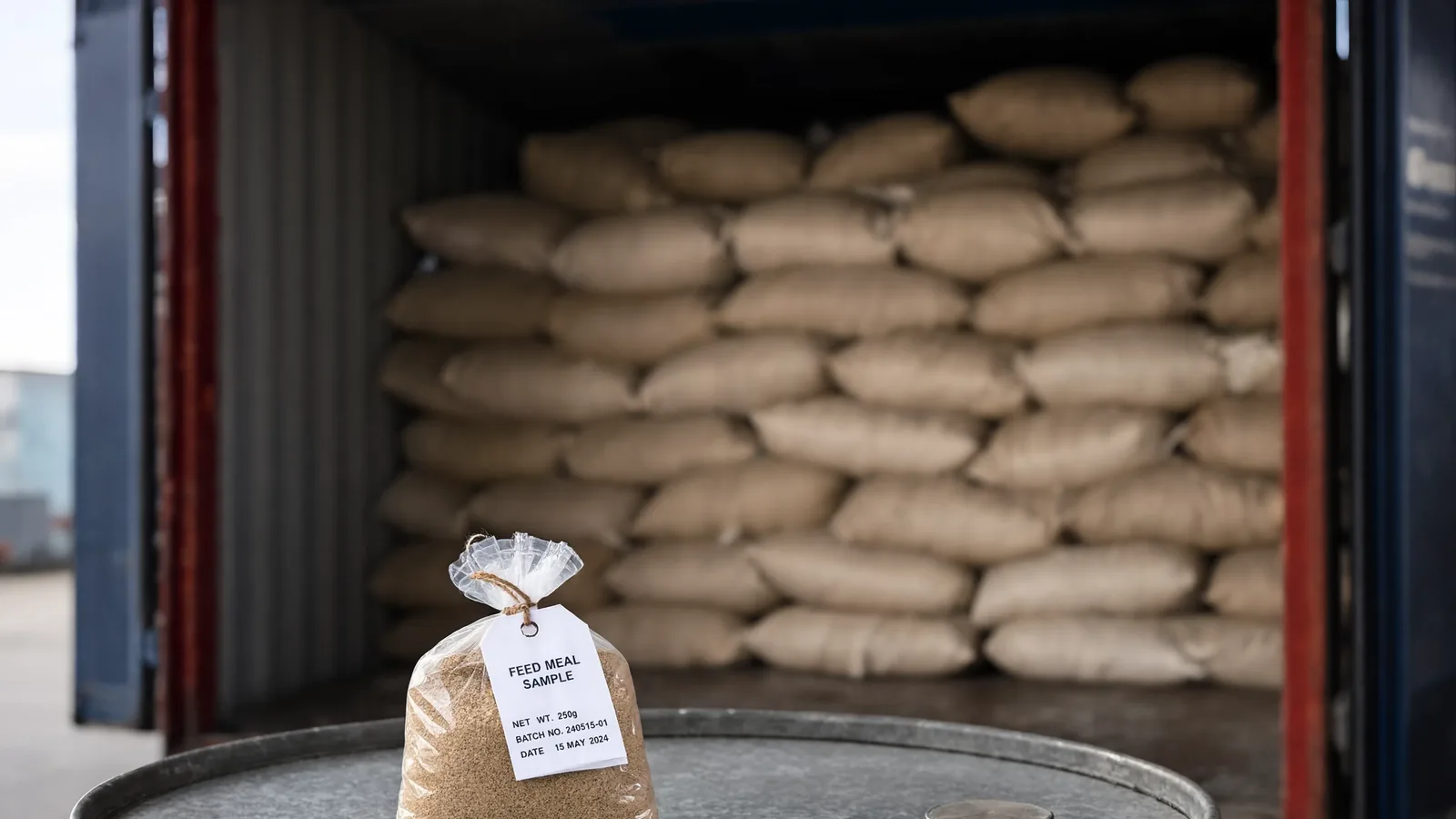
Start here, because everything else depends on it. A laboratory never saw your twenty-six tonnes. It saw perhaps five hundred grams that someone, somewhere, scooped out of the lot and put in a bag. Every number on that certificate is a statement about those five hundred grams. It becomes a statement about your container only to the degree that the sample honestly represented the container — and that is a much bigger "only" than the confident decimal places suggest.
Here is the fact that almost no one in this trade internalises: sampling error usually dwarfs laboratory error. A competent lab running a standard method will reproduce a protein result within a few tenths of a percent. The difference between two samples honestly drawn from opposite ends of the same lot can be several times that — and for a contaminant like aflatoxin, it can be an order of magnitude. When people argue about a COA, they almost always argue about the lab. The lab is rarely the problem.
What a composite sample is, and why it matters
A defensible sample is not one scoop. It is many small increments taken across the lot — from different bags, different points in the flow, different depths — combined, mixed, and reduced down to a laboratory portion. That is a composite sample, and the number of increments and where they came from is a specification in its own right. Ten increments from the top layer of a bulk hold is not a composite sample. It is a sample of the top layer, which in a lot that has segregated during a three-week voyage may be a genuinely different material from what sits at the bottom.
Sampling frequency is the other half. One certificate per shipment tells you less than one per production batch, and one per production batch tells you less than one per batch with retained samples held by both sides. The finer the sampling, the smaller the piece of material each number is actually responsible for — and the smaller the surprise when you test at intake.
Two honest samples can disagree, and nobody is lying
This is the scenario that ends commercial relationships unnecessarily. The supplier's retained sample says 46.2% protein. Your port-drawn sample says 44.9%. Somebody is cheating — that is the instinctive reading, and it is usually wrong. The two samples were drawn at different times, from different parts of a heterogeneous mass, possibly by different methods, and tested by different labs running the same nominal method with different equipment. Both results can be correct descriptions of the material each lab received. The material was simply not uniform, which no bulk agricultural commodity ever is.
The mature response is not to accuse anyone. It is to have agreed, in the contract, before the container sailed, how a disagreement gets settled: whose sample, which lab, what tolerance, who pays. We come back to that at the end, because it is the single most valuable paragraph in a feed purchase contract and the one most often left out.
Proximate analysis: what each number means and what it hides
The block of numbers at the top of almost every feed COA — protein, fat, fibre, moisture, ash — is the proximate analysis. The scheme is over a century old and it survives because it is cheap, fast and standardised. It also answers a set of questions that are only loosely related to the questions you actually have. Each of these numbers is a category, not a compound.
Crude protein is a nitrogen measurement
This is the most important sentence on the page and the least understood. The standard methods do not measure protein. They measure nitrogen, then multiply it by a fixed factor — 6.25 for most feed ingredients — on the assumption that the nitrogen came from protein and that protein is about 16% nitrogen. It is an assumption, and it is why the number is called crude protein rather than protein.
The consequence is uncomfortable: anything nitrogen-rich raises the number, whether an animal can use it or not. Non-protein nitrogen, excess urea, and — as the feed and food industry learned globally and expensively about two decades ago — deliberately added nitrogen-bearing compounds such as melamine all read as protein to a method that only counts nitrogen atoms. That episode is not a reason for paranoia. It is a reason to understand that crude protein is a proxy, and that a proxy can be satisfied without the thing it stands for being present.
The everyday version of the problem is more mundane and costs more money in total. Crude protein says nothing about amino acid availability. Two batches at an identical 46% can deliver materially different digestible lysine if one of them was over-heated during processing — heat damage binds lysine into forms the animal cannot absorb, and the nitrogen is still there, still counted, still on the certificate. The bird does not eat crude protein. It eats digestible amino acids. If your formulation matrix runs on crude protein, you are formulating on a number that has already agreed to lie to you.
Moisture: the number that silently repriced your purchase
Moisture looks like housekeeping. It is arithmetic. You are not buying tonnes of material, you are buying tonnes of dry nutrient, and every point of extra moisture is a point of nutrient you did not receive and did pay for. On a full container the difference between 10% and 13% moisture is not a rounding error; it is a real transfer of value, and it happens without anyone doing anything wrong.
Moisture is also the number most likely to have moved between the supplier's lab and yours, and in this region it moves in a predictable direction. That is a Gulf problem specifically, and we deal with it below. For now: always know whether a specification is quoted as-is or on a dry matter basis. Comparing an as-is number to a dry-matter number is a mistake buyers make regularly, and it always favours whoever chose the basis.
Ash — and the acid-insoluble ash trick
Ash is what is left after you burn the sample: total minerals. On its own it is a weak number, because it cannot tell the calcium you want from the sand you do not. Acid-insoluble ash can. Silica and soil survive an acid wash; genuine feed minerals largely dissolve. So a normal ash with an elevated acid-insoluble ash is one of the cleanest adulteration signals available — it says the mineral content is not the mineral content you were sold. It is inexpensive to run, it is rarely on a standard panel, and for any ground or milled ingredient bought on price it is worth asking for by name.
Fibre: crude fibre is the wrong tool for roughage
Crude fibre is a survivor of the old scheme and it is close to useless for forage. The method dissolves away a variable and unknown share of the material you care about, so the number under-reports the real structural fibre and does it inconsistently across feedstuffs. NDF and ADF replaced it for good reason: NDF tracks total cell wall and predicts how much the animal can physically eat, ADF tracks the least digestible fraction and predicts energy. For hay, straw, barley and any roughage-bearing purchase, a COA offering crude fibre and no NDF/ADF is offering you the wrong measurement. Ask for the right one.
Crude fat, or ether extract, has a smaller version of the same issue: it is everything the solvent pulled out, which is fat plus whatever else was fat-soluble. For most purchases that is close enough. For a fat-bearing ingredient it should never be read alone — see peroxide value below, because the fat number tells you how much there is and says nothing at all about whether it is still good.
| The number | What it tells you | What it does not tell you |
|---|---|---|
| Crude protein | Total nitrogen × 6.25 — a ceiling on the protein present | Whether the nitrogen came from protein at all, and whether the amino acids are available to the animal |
| Moisture | Your true price per unit of dry nutrient; a first read on storage risk | Where the water sits — surface moisture and bound moisture behave very differently in a Gulf warehouse |
| Crude fat / ether extract | How much fat-soluble material is present | Whether that fat is fresh or already oxidising — that is peroxide value's job |
| Crude fibre | Very little, honestly — a rough bulk indicator | Intake potential or energy. Use NDF and ADF for anything roughage-based |
| Ash | Total mineral content | Which minerals. Add acid-insoluble ash to separate nutrition from sand and soil |
Process indicators: the numbers you read in pairs
Proximate analysis tells you roughly what is in the bag. Process indicators tell you what was done to it, and for heat-treated ingredients that is often the more valuable information. The defining feature of this group is that no single one of them means much alone. They are read against each other, because the thing you are trying to detect sits between two failure modes: not enough heat and too much.
Under-processed soy leaves trypsin inhibitor intact, and trypsin inhibitor disables the enzyme the animal needs to digest protein — you paid for protein and bought a blocker. Over-processed soy destroys the trypsin inhibitor beautifully and damages lysine on the way. Both failures can present with a perfectly respectable crude protein. The process indicators are how you tell them apart.
- Trypsin inhibitor activity (TIA). The direct measurement of the anti-nutritional factor itself. Low is good. High means under-processing, full stop. Ask for the unit and the method — TIA is reported on more than one scale and the numbers are not interchangeable between them.
- Protein solubility (commonly in KOH). Falls as heat rises. A low solubility says the protein has been cooked hard — which is exactly the condition that damages lysine. This is the over-processing sentinel, and it is the one most often missing from a certificate.
- Urease activity. Fast, cheap, and an indirect proxy for under-processing in soy. It is a screening tool, not a verdict, and it loses resolution precisely in the well-processed range where you most want detail. Treat a good urease result as permission to keep looking, not as an answer.
Now the pairing. TIA alone can be low because the material was processed correctly — or because it was cremated. Protein solubility alone can be high because the material was handled gently — or because it was barely heated at all and is still full of inhibitor. Read together, they bracket the answer: TIA low and solubility healthy means the processor hit the window. TIA low and solubility low means they overshot, and your lysine went with it. TIA high and solubility high means they undershot. That is the whole logic, and it is why a certificate with one of the pair and not the other is telling you half a story.
The contaminant panel: where the sampling problem gets serious
Everything so far has been about value. This section is about liability. A nutritional miss costs you performance; a contaminant miss can cost you a herd, a customer, or a licence. And this is exactly where the sampling problem from the first section stops being academic.
Mycotoxins, and why one number is not reassurance
Mycotoxins do not distribute evenly through a lot. They distribute in pockets. Mould grows where moisture and temperature let it grow — a wet spot in a hold, a corner of a silo, one section of a field harvested in the wrong week — and the toxin stays broadly where the mould was. A lot can be genuinely clean across ninety-nine percent of its mass and carry a hot pocket that would fail any limit you care to name.
This is why aflatoxin B1 is the number where sampling discipline matters more than anywhere else on the certificate. A single scoop that misses the pocket returns a beautiful result and tells you nothing. A proper composite across many increments is the only sampling that has a real chance of finding it — and even then, mycotoxin results carry more uncertainty than nutritional ones, which is a property of the material and not a failure of the lab. Treat a low aflatoxin figure from an unknown sampling protocol as unverified rather than as good news.
On limits: do not take a number from an article, including this one. Permitted levels differ by toxin, by species, by intended animal, and by destination country, and they are revised. Confirm the current requirement with the authority for the market the goods are actually going to — the UAE and each GCC state set and update their own, and a limit you remember from a shipment two years ago is not a defence at inspection.
Heavy metals, microbiology, and peroxide value
Heavy metals — lead, cadmium, arsenic, mercury — are the quiet panel. They are not a processing failure; they are a function of where the crop grew and what the material touched afterwards. They also accumulate, which makes them a food-chain question and not only an animal-health question. Mineral sources, fishmeal and anything with a soil or industrial history deserve a real panel rather than a reassuring sentence.
Microbial parameters generally mean salmonella first, then enterobacteria and total counts as indicators of hygiene through processing and handling. Salmonella is a presence/absence question in a stated sample size — and note that the sample size is part of the result. "Absent" means absent in the quantity tested. A larger tested quantity is a stronger statement. If the certificate does not state the size, the word absent is doing less work than it appears to.
Peroxide value belongs on any fat-bearing ingredient and is routinely left off. Fat oxidises. Oxidised fat loses energy value, wrecks palatability, destroys vitamins sitting next to it in the mix, and does it progressively rather than at a threshold. Crude fat tells you the quantity; peroxide value tells you the condition. In this climate a rising peroxide value is not an exotic risk, it is a scheduled one — which brings us to the two sections that matter most commercially.
The method decides the number — and "typical" decides nothing
Two labs. Two methods. Two different numbers. Both correct. This is not a hypothetical; it is a Tuesday. A result without a stated method is not a specification, it is a rumour with a decimal point.
The clearest example is the one buyers of processed soy meet constantly. "Protein solubility 82%" and "peptide content 25%" sound like they describe the same underlying property, and in a loose sense they do. But solubility in KOH, solubility in water, and a peptide fraction determined after a TCA precipitation are three different measurements answering three different questions. Numbers from them cannot be compared, ranked, or put in the same tender evaluation. A supplier quoting "peptides 25%" with no method has not given you a specification — they have given you a marketing figure that happens to have a percent sign, and you cannot hold them to it because there is nothing to hold.
So the question is always the same, and it is one line in an email: which method, on which basis, in which units. A serious supplier answers it immediately because their lab already knows. An answer that takes a week is itself information.
The typical-value trap
Datasheets are full of the phrase "typical value", and buyers read it as a promise. It is the opposite of a promise. A typical value is a description of what the supplier's product has tended to look like — a historical average, sometimes a marketing round number, occasionally an aspiration. It carries no commitment about the batch on your truck, and it is not the supplier's fault if you treat it as one, because they wrote the word typical right there.
The test is blunt: a specification with no tolerance and no rejection threshold is not a contract term. "Protein 46%" is not enforceable. "Protein minimum 45.0%, referee method Kjeldahl, tolerance 0.5 points, below 44.0% rejectable at buyer's option" is enforceable. The difference between those two lines is the difference between a conversation and a claim. If the only protein figure anywhere in your paperwork is a typical value on a PDF, you have no protein specification — you have a hope with a logo on it.
Red flags on the page
Some of these are sloppiness and some are worse. You usually cannot tell which from the document alone, and it does not matter much: the response is the same. Ask, in writing, before the goods move.
| Red flag | Why it matters | What to do |
|---|---|---|
| No batch or lot number | The certificate cannot be tied to the goods in front of you. It could describe anything the supplier has ever made | Do not accept. A COA that cannot be traced to a batch is decoration |
| Identical numbers across several batches | Real analysis of real material has variance. Perfect consistency means the numbers were copied, not measured | Request the raw lab reports for three consecutive batches and compare |
| Analysis date before the production date | The lab tested something. It was not this batch | Stop the release and ask for the batch-specific report |
| No method stated next to a result | The number is not comparable to anything, including your own intake test | Ask for method, basis and units before you agree a spec |
| A range where a result belongs | "Protein 44–48%" is a spec, not a measurement. This batch has one protein content | Ask what the batch actually assayed at |
| A laboratory you cannot find | No accreditation, no address, no scope — nobody stands behind the result | Verify the accreditation and its scope, or nominate a referee lab yourself |
Put it in the contract — and the Gulf layer on top
Every problem in this article is solvable, and all of them are solvable at the same moment: before the container sails. Afterwards you are negotiating from a position where the goods are already yours and the pressure is already on you. This is the list. It is short, it costs nothing to agree in advance, and it is the difference between a dispute and a procedure.
- The sampling protocol, in writing. Who draws, when, how many increments, from where, and how the composite is reduced. This is the clause that prevents the argument you would otherwise be having.
- Retained samples on both sides. Sealed, labelled with the batch, held for an agreed period by supplier and buyer. Without a retained sample you cannot re-test anything after the material has been used or blended, and that is precisely when you will want to.
- A named referee laboratory, agreed before you need one. Choosing a referee lab during a dispute never works — each side proposes the lab it expects to favour it. Name it at contract stage, when neither of you knows which way you will need it to go.
- Tolerances per parameter. What variance is accepted as normal analytical and sampling spread, and on which basis the figure is expressed. Without this, every decimal point is arguable.
- Rejection thresholds and the remedy. At what value you can reject, at what value you take a price adjustment instead, and how that adjustment is calculated. Agree the formula, not the principle.
- Who pays for the retest. Usually the losing side, which is the clause that keeps both parties honest about calling for one.
What changes when the destination is the Gulf
The GCC imports the overwhelming majority of its feed. That single fact means almost every batch you buy has crossed an ocean, sat in a port, and been inspected by an authority before it reaches an animal — and each of those steps interacts with the certificate in a way that buyers in producing countries never have to think about.
- The paperwork must match the destination authority, not the origin's habits. Health certificates, origin declarations and the contaminant panel need to satisfy the current requirements of the authority for the country the goods are entering — MOCCAE in the UAE, and the relevant national authority elsewhere in the GCC. Requirements change and they are not identical across the six states. A nutritionally perfect batch with the wrong documents does not get a discount; it sits.
- Heat and humidity move numbers between the supplier's COA and your intake test. Moisture migrates in a container crossing the tropics and sitting on a quay in July. Peroxide value climbs in fat-bearing material held warm. Neither is anyone cheating — it is physics on a schedule. So decide in the contract which point in the journey the specification applies at: loading, discharge, or intake. That one sentence resolves an entire category of dispute before it exists.
- The referee clause is what saves you at Jebel Ali. When a container is already discharged, demurrage is running and your mill needs the material, you have no time to negotiate a process from scratch. A retained sample and a pre-agreed referee lab turn a week of arguing into a two-day test. That is not a legal nicety; it is a demurrage line item.
- Use a regional lab for intake, and know its scope. Testing locally shortens the loop and gives you a result on the material as it actually arrived rather than as it left. Check that the lab's accreditation covers the specific parameter you are asking about — accreditation is granted per method, not per building.
Frequently asked questions
My COA and my intake test disagree. Has the supplier cheated me?
Probably not. Sampling error usually exceeds laboratory error by a wide margin, so two honestly drawn samples from different parts of a heterogeneous lot can legitimately return different results — especially for mycotoxins, which sit in pockets rather than spreading evenly. Before alleging anything, check whether the two samples were drawn the same way, whether both labs ran the same method on the same basis, and whether the gap exceeds your contracted tolerance. That is what the referee lab clause is for.
Can crude protein on a COA be misleading?
Yes, in two distinct ways. First, the standard methods measure nitrogen and multiply by a factor — so any nitrogen-rich material raises the figure whether or not the animal can use it. Second, and far more common, crude protein says nothing about amino acid availability: a heat-damaged batch can show an excellent protein figure while delivering materially less digestible lysine. Formulate on digestible amino acids and read crude protein alongside a process indicator such as protein solubility.
What is the aflatoxin B1 limit for feed imported into the UAE?
Do not take that figure from an article — including this one. Permitted levels vary by toxin, by target species and by country, and they are revised periodically. Confirm the current requirement with the competent authority for the market the goods are actually entering, per shipment. What is constant is the testing discipline: mycotoxins distribute unevenly, so a low result from a single scoop proves very little. Insist on a proper composite sample and a lab accredited for that specific method.
A supplier gives typical values but will not commit to a specification. Is that normal?
It is common, and it is not acceptable on a material purchase. A typical value is a historical description, not a promise about your batch, and a figure with no tolerance and no rejection threshold is not a contract term — there is nothing to enforce. Ask for a minimum or maximum, the referee method, the basis, a tolerance and a rejection point. A supplier who genuinely controls their process can give you all five. Reluctance to commit usually means the variance is wider than the datasheet implies.
The bottom line
A certificate of analysis is not a guarantee and was never meant to be one. It is a measurement of a sample, taken by someone, using a method, at a moment in time — and every one of those four qualifiers is a place where the number can drift away from the material sitting in your shed. Read that way, a COA is one of the most useful documents in the trade. Read as a warranty, it is a comfort blanket you paid for.
So here is the position, and it is not a comfortable one for anybody selling feed, us included. The certificate is the least important half of feed quality assurance. The important half is the protocol around it — how the sample was drawn, which method produced the number, what tolerance was agreed, who the referee is, and what happens when the two sides disagree. Suppliers compete on the numbers because numbers are easy to print. Buy on the protocol instead. The trader who will walk you through their sampling and name their method without being pushed is telling you more about their quality system than any certificate they could hand you — and the one who will not has already answered the question.
Sourcing this, or trialling it?
We trade animal and bird nutrition from Dubai, in direct contact with the manufacturers behind every product, with a certificate of analysis on every batch. Tell us the specification you need and we will tell you honestly whether we are the right supplier for it.