Shell quality drops. The grader starts throwing out more cracks. Somebody looks at the feed tag, sees a calcium figure, and asks the mill to push it up. This happens on farms everywhere, and in the Gulf it happens every July. It is the most predictable reflex in layer nutrition and it is usually wrong — not slightly wrong, but wrong in a way that can make the problem worse while costing you money and convincing you that you have already dealt with it.
The hen is almost never short of calcium in the bag. She is short of calcium at two o'clock in the morning. Those are completely different problems and only one of them is solved by a bigger number on the label. Once you understand why, most of what follows — particle size, split feeding, phase programmes, why summer thins the shell even on a diet that is technically correct — stops being a list of tricks and becomes one idea applied in several places.
The shell is built at night, and she is not eating
Take the biology in one pass, because everything practical hangs off it. A hen ovulates in the morning. The egg travels down the oviduct, and it spends the large majority of its formation time in the shell gland, where calcium carbonate is laid down onto the membrane. That deposition runs for many hours and it is at its most intense overnight — in the dark, in a house where the lights are off and the birds are not eating.
So the shell gland is drawing hard on blood calcium at exactly the hours when nothing is coming in through the beak. There are only two places that calcium can come from. Either it is still being released from feed sitting in the hen's gizzard, or it is pulled out of her own skeleton. That is the whole story. Every practical decision in this article is about making sure the first source is available so that the second one is not needed.
Why the gizzard is the whole argument
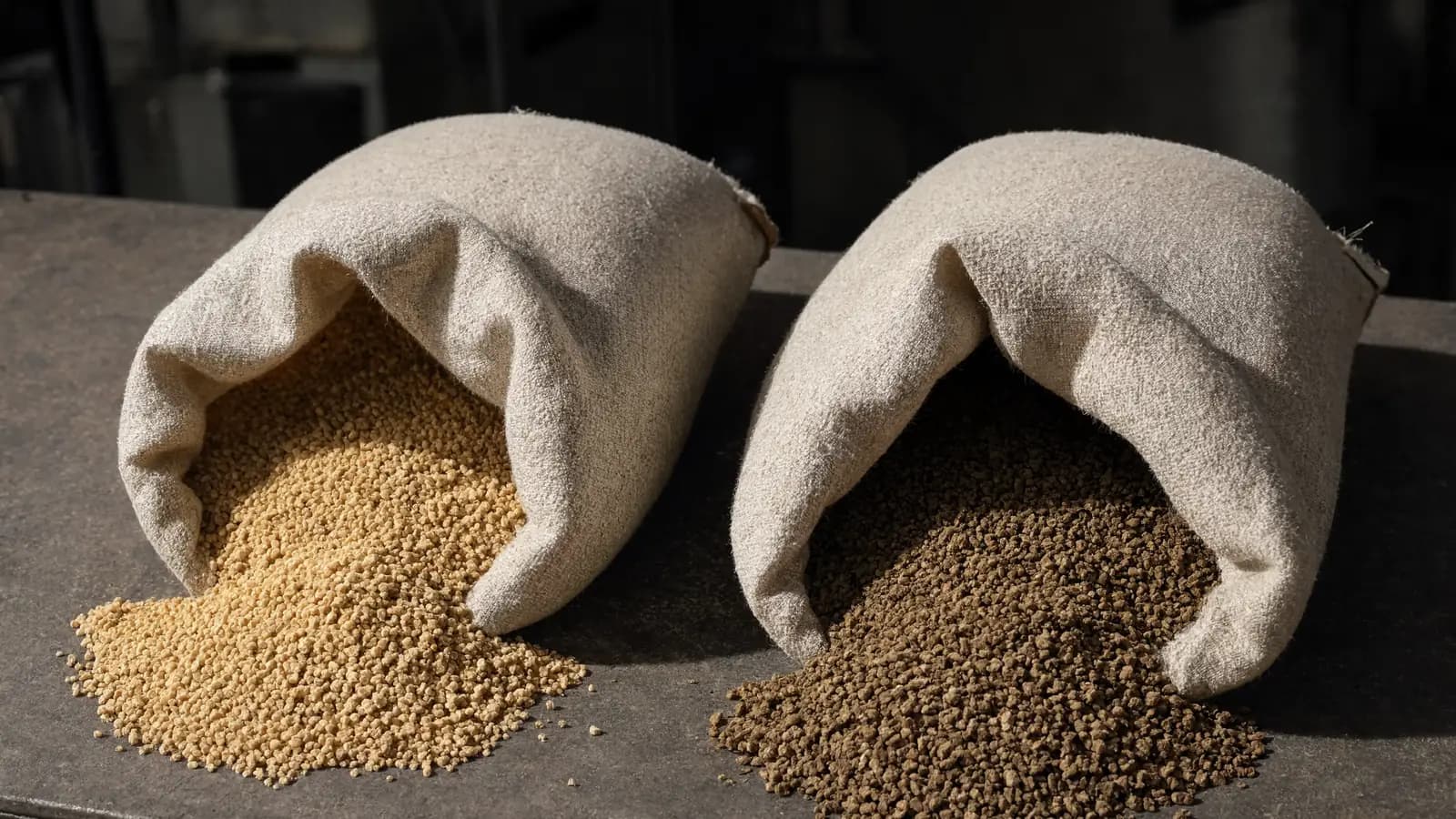
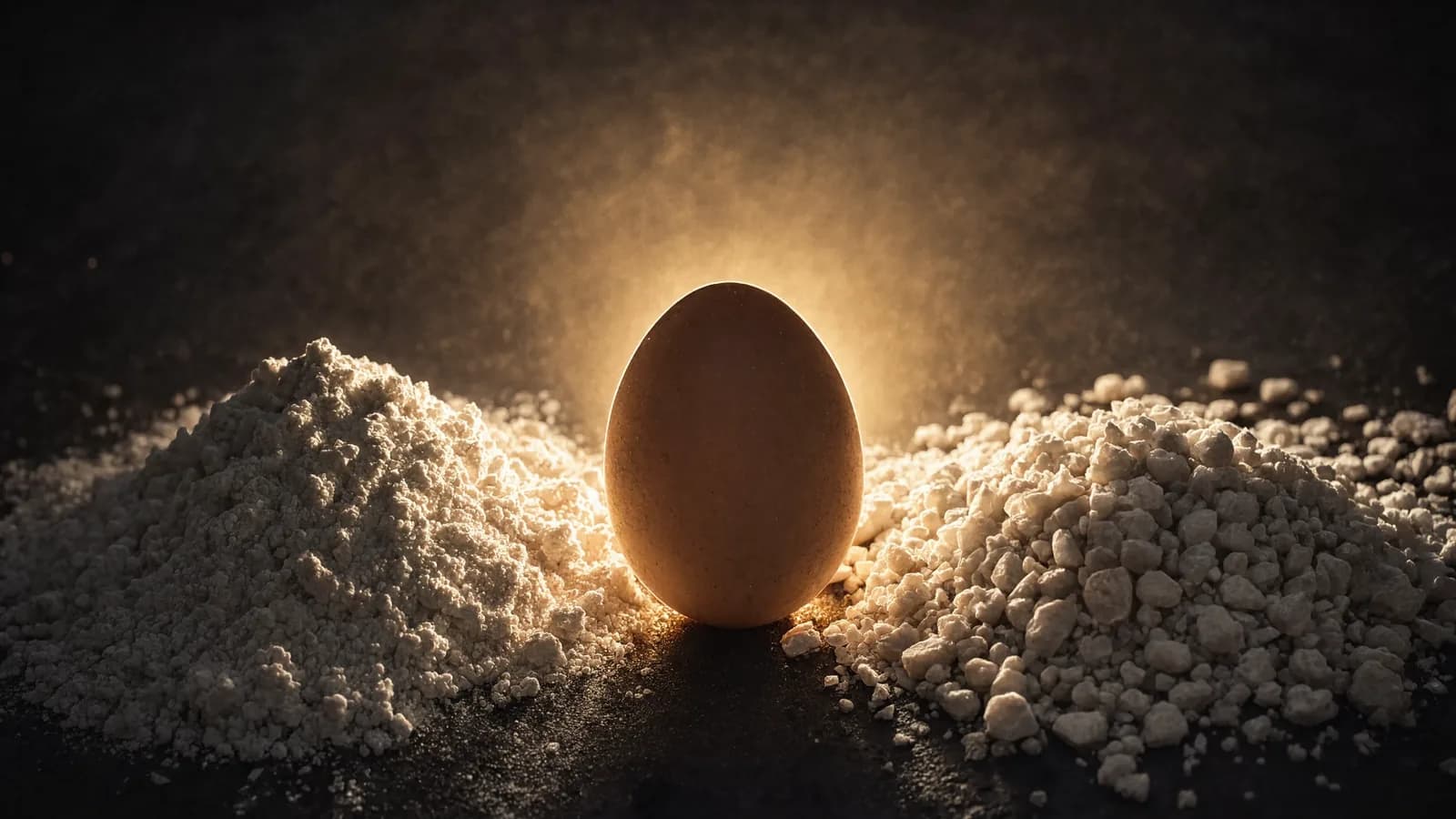
Fine, powdery limestone behaves like a soluble ingredient. It leaves the gizzard quickly, dissolves in the upper gut, and the calcium it carries is absorbed and dealt with within a few hours of the meal. If the hen eats it in the morning, it is long gone by the time the shell gland needs it. Coarse limestone and oyster shell behave completely differently. Particles above a certain size are retained in the gizzard — that is what a gizzard does, it holds hard material and grinds it down — and they dissolve slowly against gizzard acid over many hours.
That is a slow-release depot. It sits in the bird, upstream of everything, quietly feeding calcium into the blood through the night at roughly the rate the shell gland is spending it. Same element, same tonne of limestone, same percentage on the tag — an entirely different physiological outcome, decided by nothing more sophisticated than how coarsely the material was crushed.
What happens when the overnight supply fails
The hen does not stop building the shell. She cannot — the egg is already in the shell gland and it is coming out either way. So she takes the calcium from the only other store she has, which is her own bone. Medullary bone exists precisely for this, and a well-fed hen mobilises and rebuilds it every day without harm. The problem is chronic, one-directional withdrawal: night after night of borrowing with no daytime repayment, month after month, through a year of lay. Skeletal reserves come down. This is the road to cage layer fatigue and to the fragile skeleton that turns routine handling and depopulation into breakages. A bird sitting on a thin shell and a weak frame at the same time is telling you one thing, not two.
Notice what raising dietary calcium does for that hen: nothing, if the extra calcium is fine and arrives in the morning. You have added cost and changed the daytime blood calcium curve, which was never the constraint. The 2am gap is still there.
Split feeding: putting the calcium where the clock needs it
If timing is the problem, timing is the lever. Split feeding — sometimes called afternoon calcium — means splitting what the flock receives across the day rather than presenting one uniform diet from lights-on to lights-off. The morning portion leans towards the things she needs while she is actively eating and forming the rest of the egg. The afternoon portion carries the coarse calcium fraction, so that when the lights go out there is a gizzard full of slowly dissolving particles sitting exactly where they need to be.
Mechanistically it is clean, and it aligns with something hens already do on their own: given free choice, a laying hen will go and eat coarse calcium late in the day. She knows. The intervention is simply making sure the material is in front of her when she wants it.
Now the honest part. This is a management change, not a purchase. Someone has to run a second distribution, at a fixed hour, every day, and be as disciplined about it on a Friday in August as on the day the nutritionist visited. It has real labour implications and it depends on your feeding system being able to deliver a different portion at a different time without the two blurring into one. On some houses that is straightforward. On others it is genuinely not worth it, and free-choice coarse calcium offered in a separate hopper gets you a good part of the benefit for a fraction of the disruption. Decide honestly which farm you are.
Why simply raising calcium backfires
Our layer feed carries 3.5–4% calcium and 16–18% crude protein. Those are not arbitrary numbers and they are not a ceiling somebody forgot to raise. A layer diet is already one of the most mineral-loaded feeds in commercial agriculture. Limestone is bulk, it is inert, and every additional kilogram of it in a tonne of feed physically displaces a kilogram of something else — energy, protein, amino acids, the vitamin and trace mineral premix. You did not add calcium to the diet. You diluted the diet with calcium.
It gets worse. Excess dietary calcium depresses feed intake — the diet gets less palatable and more bulky, and the bird eats less of it, which means she consumes less of everything, including the calcium you just added. Calcium in excess also interferes with the absorption of other minerals in the gut: phosphorus availability suffers, and so do zinc and manganese, which have their own roles in shell membrane and matrix formation. So the wrong reflex spends money, reduces intake, degrades trace mineral status, and leaves the overnight timing gap untouched. That is four failures in one decision.
Ca:P and vitamin D3 — calcium does not work alone
Calcium and phosphorus are one system, not two line items. They are absorbed, transported, stored and mobilised together, and it is the balance between them — Ca:P, expressed on available phosphorus rather than total — that the bird actually responds to. Push calcium up without touching phosphorus and you have not just added calcium, you have moved the ratio, and a ratio that has drifted too far in either direction costs you performance even when both absolute numbers look defensible on paper.
Vitamin D3 sits above both. Without adequate D3 status the hen cannot absorb calcium efficiently from the gut or regulate its movement in and out of bone — which means a D3 problem presents exactly like a calcium problem, and adding calcium to a D3 problem does approximately nothing. Phytase belongs in the same conversation: it liberates phytate-bound phosphorus, which changes available phosphorus, which changes the ratio you thought you had formulated. Add a phytase and leave the mineral matrix untouched and you have quietly moved Ca:P without deciding to.
None of this means you should start guessing at ratios. It means shell quality is a systems question, and anyone who answers it with a single number is not looking at the system.
| What you see | The wrong reflex | Where the problem usually is |
|---|---|---|
| Thin shells across the flock, diet on spec | Raise dietary calcium | Calcium particle size — too fine, nothing left in the gizzard overnight |
| Shells thin in summer only | Change the formula | Heat stress and panting — a respiratory problem, not a formulation error |
| Shell quality falls off late in lay | Feed the peak-lay diet harder | Egg size outgrew shell deposition — needs a phase change, not more of the same |
| Some birds fine, some birds poor, same house | Blame flock uniformity | Feeder management — sorting, fines left behind, birds at the end of the chain |
| Thin shells plus bone breakages | Treat them as two problems | One problem — chronic skeletal mobilisation from failed overnight supply |
| Shell quality unresponsive to every calcium change | Add more calcium again | D3 status or available phosphorus — calcium was never the limiting factor |
Age, feed form, and the diet your birds actually eat
The hen ages, the egg grows, the shell does not
Here is the arithmetic that catches farms out. As a hen ages her eggs get bigger. Her capacity to deposit shell does not improve to match — if anything it declines. So the same quantity of shell material is being spread over a larger surface. Thickness per unit area falls. Shell quality deteriorates in late lay even when absolutely nothing about the hen's calcium metabolism has gone wrong, purely because the geometry moved.
Which means late-lay is a different nutritional problem from peak-lay, and the same diet is not right for both. At peak the hen is laying near-daily, eating well, and the job is keeping up with an enormous calcium turnover. Late in lay the rate has come off, egg size is at its maximum, and the job is holding shell thickness and protecting a skeleton that has been making withdrawals for a year. Those are different briefs. Feeding a single layer diet from first egg to depletion is the most common unforced error in this business — it is convenient, it is one SKU, and it is wrong at both ends of the cycle. Feed by phase.
Mash, crumble and the sorting problem
A hen is not a mixer. Presented with a mash, she does not eat a representative sample of it — she picks. Birds preferentially select the larger, coarser particles and leave the fine material behind. Every bird that works down the feeder is eating a diet richer in coarse particles and poorer in fines than the one you formulated, and the fines that accumulate at the bottom of the trough carry a disproportionate share of the premix, the fine minerals and the additives. That residue is your vitamin and trace mineral programme, sitting in the trough, uneaten.
This cuts both ways with coarse calcium, and it is worth being precise about the irony: selective feeding is a problem for your premix and a gift for your calcium programme. The hen will happily hunt out coarse limestone particles late in the day. What she will not do is eat the fines you needed her to eat. Crumble narrows the gap — the particles are bound together, so sorting is physically harder and each bite is closer to the formulated diet — which is one reason our layer feed is offered in both crumble and mash rather than one on principle.
And then there is the feeder chain itself, which is free to fix and almost never examined. How often does it run? Does it run often enough that fines are cleared rather than accumulating into a layer nobody touches? Is feed depth even from the first bird to the last? Are the birds at the far end of a long house getting the same diet as the birds at the hopper, or the sorted remainder of it? If your shell quality is uneven within a single house on a single diet, stop looking at the formulation. Your problem is your feeder chain, not your calcium.
Heat stress: why a Gulf summer thins shells on a correct diet
This is the one that matters most here, and it is the one most often mistaken for a feed fault. A hen has no sweat glands. Her only meaningful route for dumping heat is to pant. Panting drives off carbon dioxide. Blood CO2 falls, blood pH rises, and bicarbonate — which is the substrate the shell gland draws on to make carbonate — is depleted. The shell is calcium carbonate. Take away the carbonate half and it does not matter how much calcium is standing by.
Read that again, because it is the crux of every July argument between a farm manager and a feed supplier. Summer shell thinning in the UAE, Saudi Arabia and across the GCC is a physiological consequence of respiration. It is not a formulation error. Your feed did not change in June. The bird's blood chemistry did.
Compounding it: intake collapses in heat. The hen eats less precisely when you need her to eat more, so the diet she consumes delivers less of everything even though the formula on paper is unchanged. Two mechanisms, same season, both pointing the same way.
Before anything below: cooling comes first. Feed additives do not out-argue a house at forty-five degrees. Evaporative cooling is the regional workhorse and it has a real limit in coastal humidity — in Dubai, Abu Dhabi, Dammam and anywhere else on the water, a pad system loses much of its power on exactly the sticky August afternoons you needed it most. Know your house's limit before you go shopping for a nutritional answer to a ventilation problem. With that said, the nutritional and management responses are real:
- Feed in the cool hours. Shift the bulk of intake to early morning and late evening, when she will actually eat. This costs nothing and is the single highest-return summer change on most farms.
- Raise nutrient density. If she eats less, every gram has to carry more. This is the correct response to a heat-driven intake fall — and note it is the opposite of diluting the diet with extra limestone.
- Electrolytes and the acid-base question. Panting is what disturbed the blood chemistry, so the response belongs in that language. Discuss it with your nutritionist against your own water analysis rather than reaching for a generic sachet.
- Water, and the temperature of it. A hen drinks far more in heat, and she will not drink enough if the water arriving at the nipple has been sitting in a line under the sun. Flush the lines. Check the temperature at the far end of the house, not at the tank. This is the cheapest intervention on this list and the most neglected.
- Coarse calcium matters more in summer, not less. Intake is down and the overnight window is the same length. A slow-release depot is worth more when the total eaten is smaller.
Cost per saleable egg, not cost per tonne
Most farms buy feed on price per tonne because it is the number on the quote. It is also the wrong number. You do not sell tonnes of feed. You sell eggs that survive grading — and a cracked egg cost you every single dirham of feed, labour, water and power that a first-grade egg cost, then returned a fraction of the price or nothing at all. That is not a small leak. It is the leak.
So do the arithmetic yourself instead of taking anyone's word for it — mine included. Take your crack and downgrade rate at grading. Take the price gap between a first-grade egg and a downgraded one. Take the cost difference per tonne between the feed you are on and the feed you are considering, and convert it to a cost per egg using your own intake and lay rate. Now ask how many percentage points of cracks the change would have to remove to pay for itself. Run those four numbers on your own farm and one of two things happens: the case is obvious, or it collapses. Either way you stop arguing about it. What you should not do is skip the exercise and assume the cheaper tonne is the cheaper egg, because on a farm with a real crack problem the arithmetic usually says the opposite, by a margin that is not close.
This matters more in this region than most. The UAE and Saudi Arabia have pushed hard on local table-egg self-sufficiency, and the farms answering that call are competing against imported eggs while importing nearly all of their own feed inputs — grain, protein, limestone, minerals — with freight, lead times and currency all sitting inside the feed price. You do not control most of that. You do control your crack rate.
And the demand side is not flat. Ramadan moves table-egg consumption in a way every producer in the GCC plans around, and a flock whose shell quality is drifting going into a demand peak is losing saleable eggs in the weeks they are worth the most. Seasonality is a reason to fix shell quality early, not to react to it in the middle of the peak.
What to measure
You cannot manage shell quality on the impression that things seem worse lately. Four measurements, in order of how easy they are to start:
- Crack and downgrade rate at grading. You already have this. Every farm generates it daily and almost nobody analyses it properly. Plot it by week, by house, and by flock age — not as one farm-level average that hides everything. A number you already collect and never look at is the cheapest diagnostic you will ever own.
- Egg weight distribution. Not average egg weight — the distribution. Average weight hides the tail, and the tail is where the shells are thinnest, because those are the biggest eggs spreading the same shell over the most surface. If your downgrades are concentrated in your heaviest eggs, you have an age and phase problem, and no calcium decision will touch it.
- Feed intake, measured honestly. Per bird per day, house by house, tracked over time and not calculated backwards from what was delivered. Intake is the variable that quietly invalidates every formulation assumption you have, and it moves most in exactly the season you care about.
- Shell breaking strength or thickness, if you have the gear. The direct measurement, and the only one that tells you about shells rather than about their consequences. If you own a gauge, use it on a fixed sample on a fixed day — a series is worth vastly more than an occasional reading. If you do not own one, the first three still get you most of the way.
Frequently asked questions
My shells are thin. Should I just ask the mill to raise the calcium?
Almost certainly not. A layer diet is already heavily mineral-loaded, and extra limestone displaces energy, protein and premix from the same tonne, depresses feed intake and interferes with phosphorus and trace mineral absorption. It also does nothing about timing, which is usually the real fault. Check calcium particle size, feeder management and — if it is summer — heat before you touch the percentage.
Why does shell quality drop every summer even though the feed has not changed?
Because the bird changed, not the feed. A hen cools herself by panting, panting drives off carbon dioxide, and that depletes the blood bicarbonate the shell gland uses to make carbonate. The shell is calcium carbonate — starve the carbonate side and calcium cannot compensate. Heat also cuts feed intake. Cooling and ventilation come first; feeding in cool hours, water temperature and nutrient density come next.
Is split feeding worth the labour on a commercial layer farm?
Sometimes. The mechanism is sound — the coarse calcium fraction goes out later so it is sitting in the gizzard overnight when the shell gland needs it. But it means a second distribution at a fixed hour, every day, with real discipline and a feeding system that can deliver two portions without blurring them. If that is not realistic, offering coarse calcium free-choice in a separate hopper captures much of the benefit with far less disruption.
Should late-lay hens get the same diet as peak-lay hens?
No, and running one layer diet from first egg to depletion is one of the most common avoidable errors in the business. As the hen ages her eggs get bigger while shell deposition does not improve, so the same shell material spreads over more surface and thickness falls. Late lay is about holding shell thickness on a large egg and protecting a skeleton that has been mobilising for a year. That is a different brief from peak. Feed by phase.
The bottom line
Take a position on this, because sitting on the fence costs you eggs. Calcium percentage is the least interesting number in the shell quality conversation, and the industry's habit of reaching for it first is the reason so many farms spend a year chasing a problem they never diagnosed. The hen needs calcium dissolving in her gizzard at two in the morning. Particle size decides whether it is there. Timing decides whether it arrives. D3 and available phosphorus decide whether she can use it. Her age decides how far it has to stretch. Panting decides whether the carbonate half of the shell exists at all. And your feeder chain decides whether the diet you formulated is the diet she ate.
Six levers, and the one everybody pulls is not among them. Go and look at your crack rate by house and by flock age this week — you are already collecting it — then go and look at the calcium in your bag and ask whether any of it would still be in a gizzard at midnight. That is the job. The percentage on the tag was never the job.
Sourcing this, or trialling it?
We trade animal and bird nutrition from Dubai, in direct contact with the manufacturers behind every product, with a certificate of analysis on every batch. Tell us the specification you need and we will tell you honestly whether we are the right supplier for it.