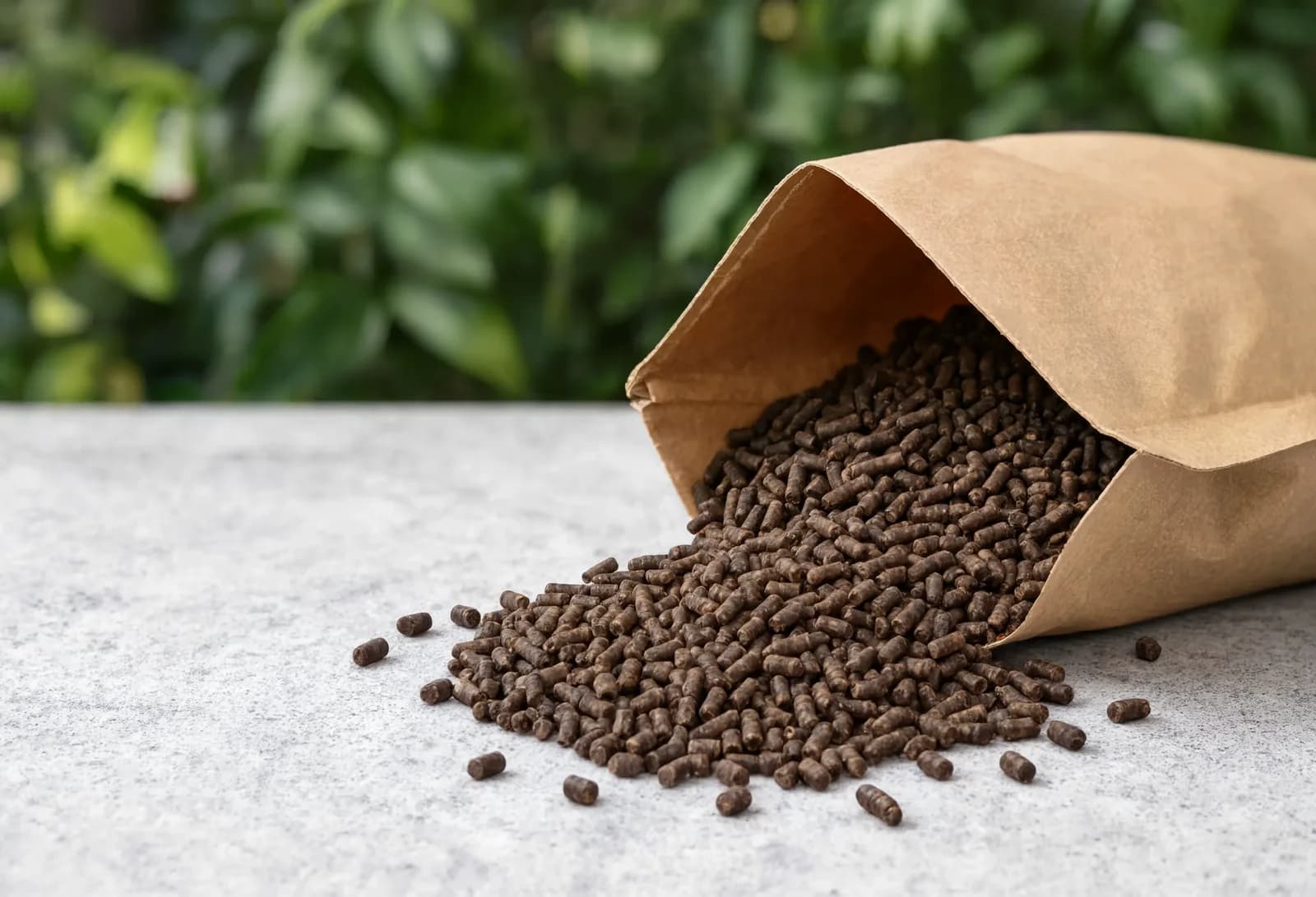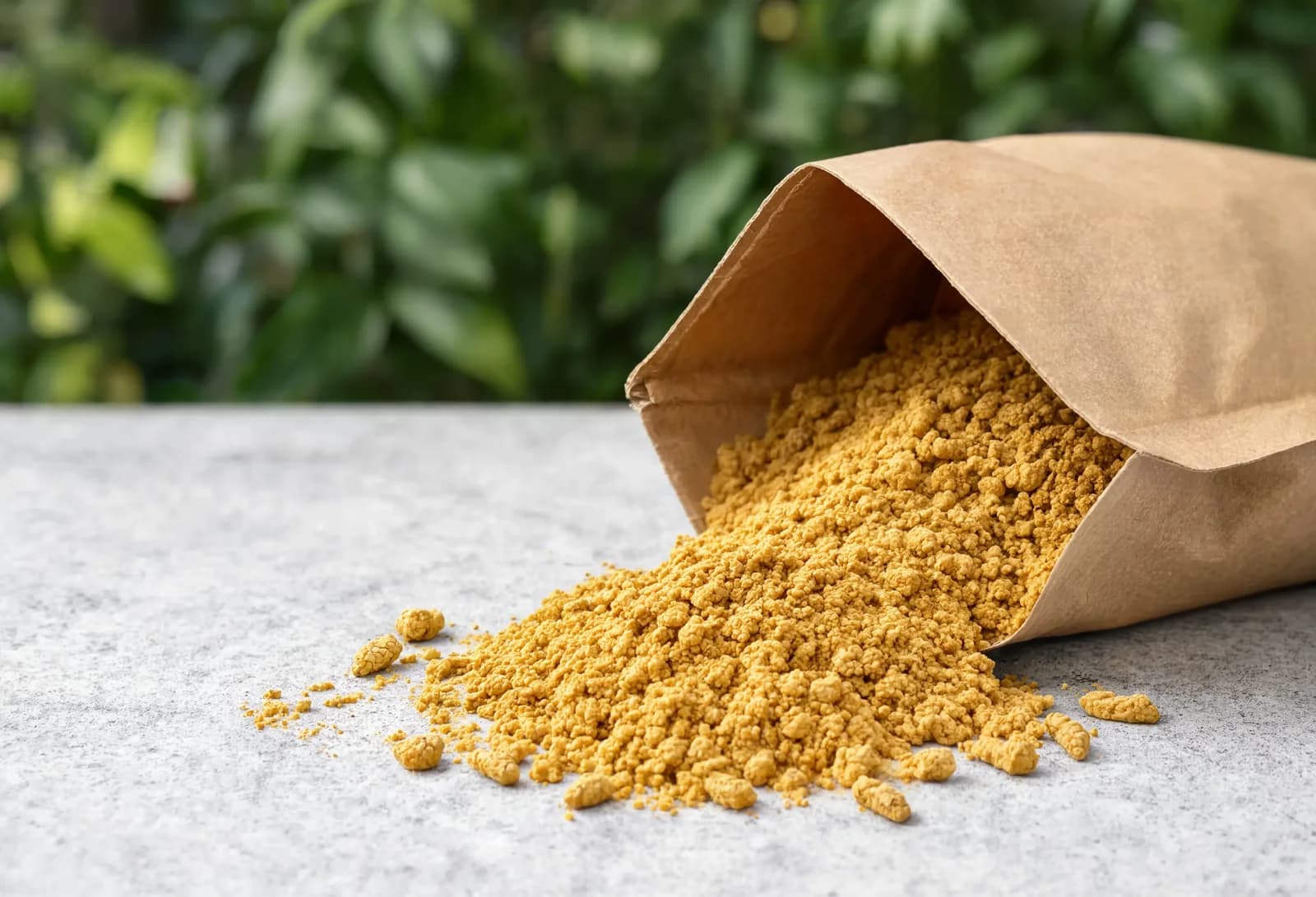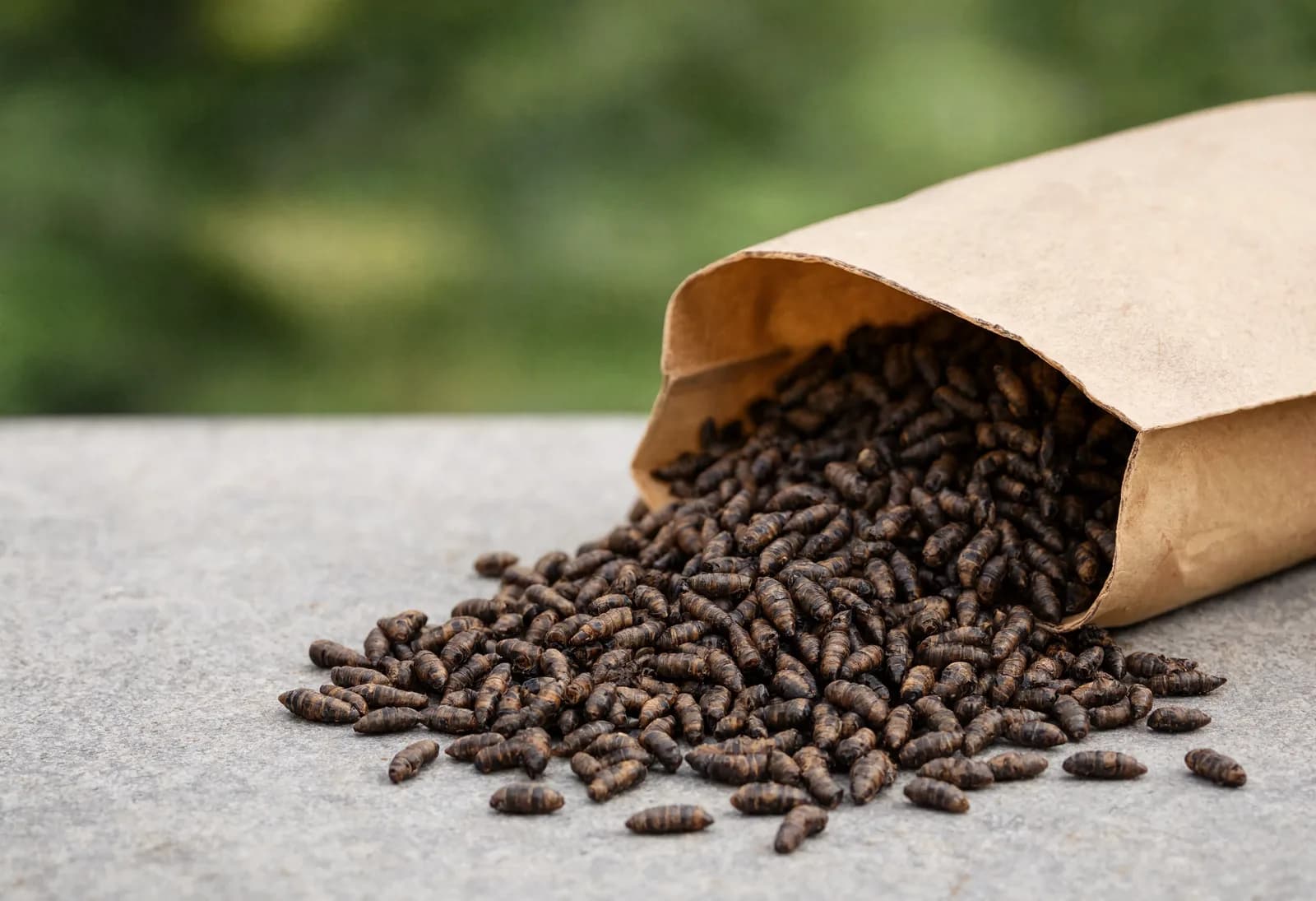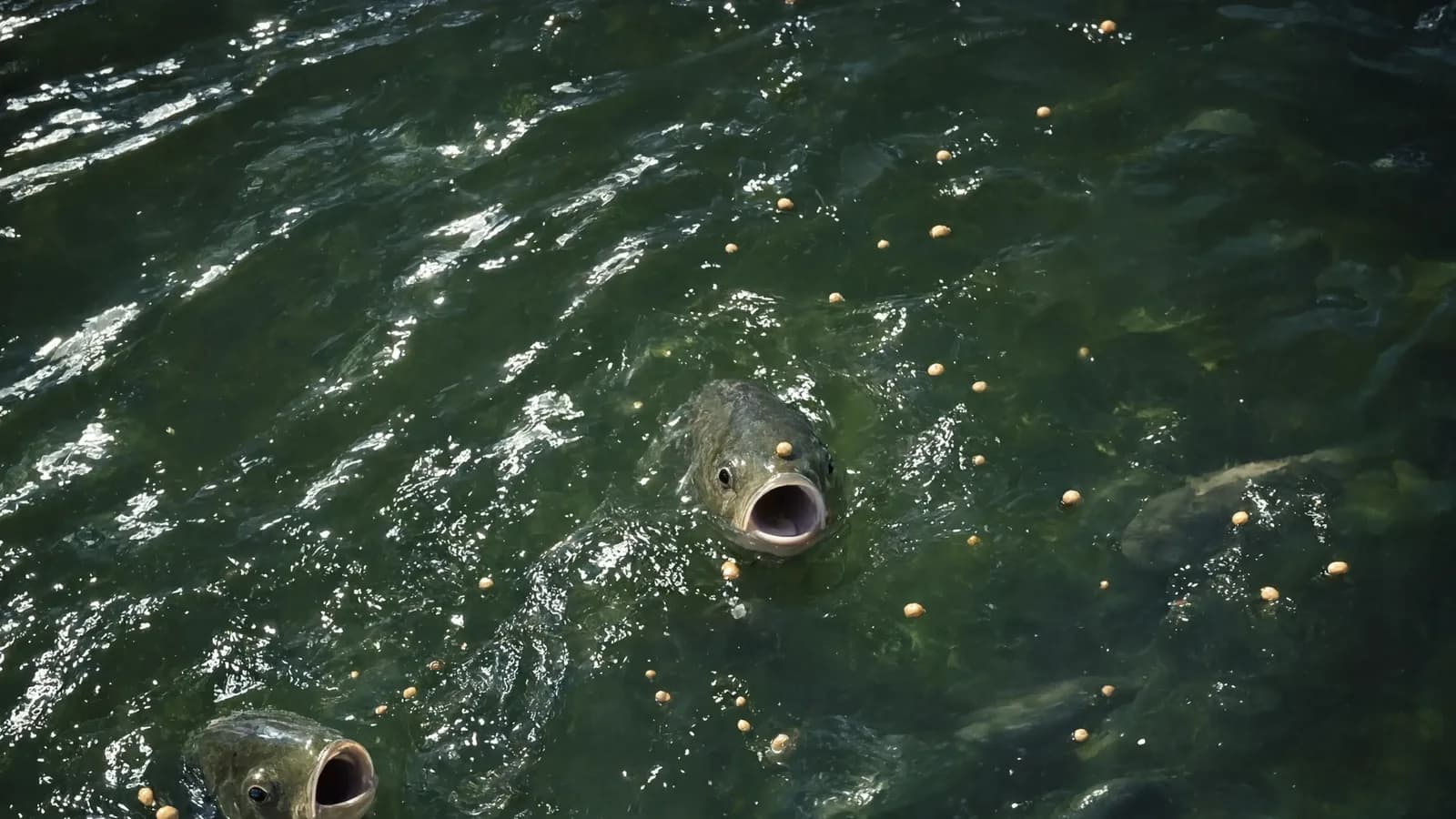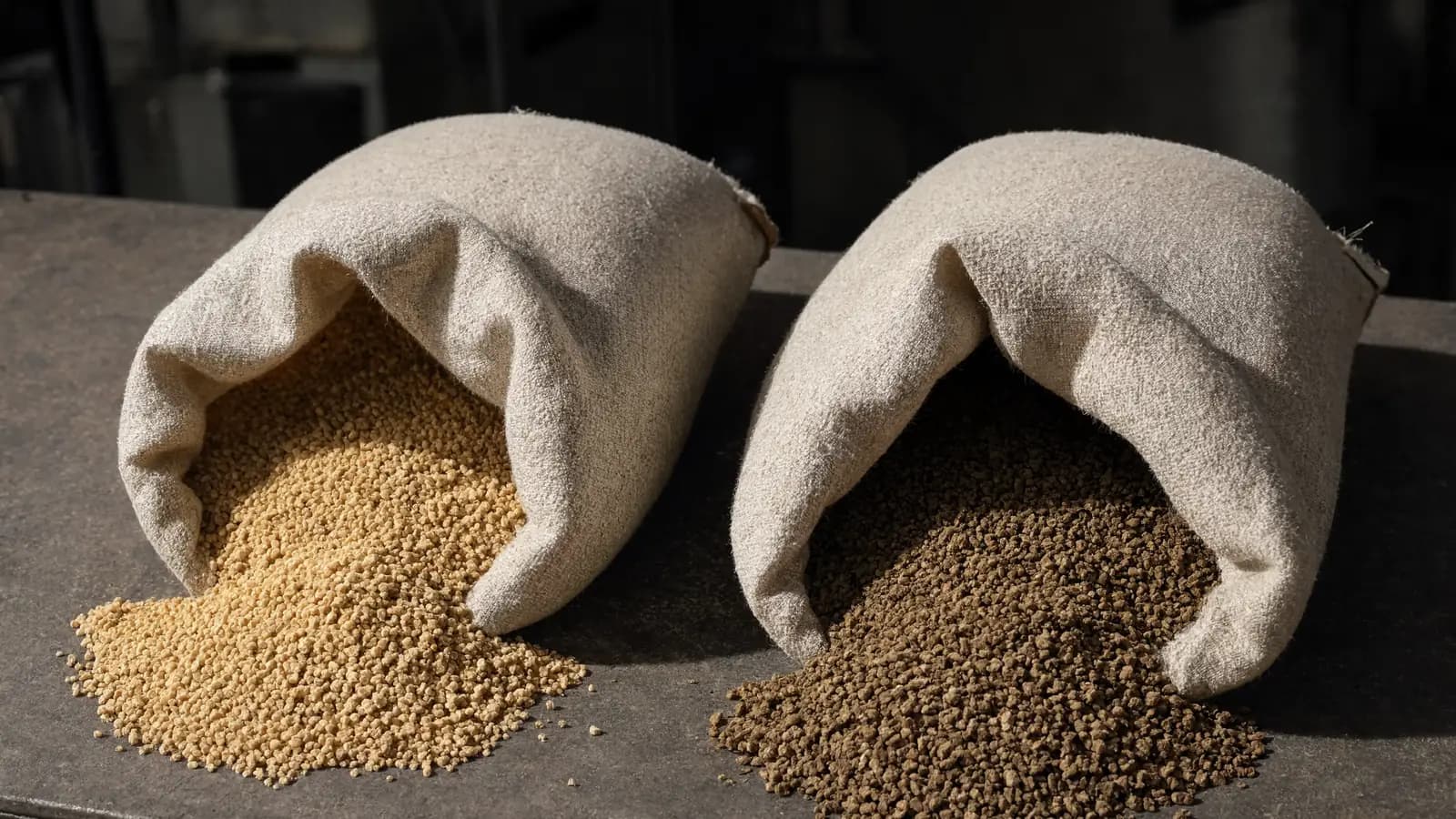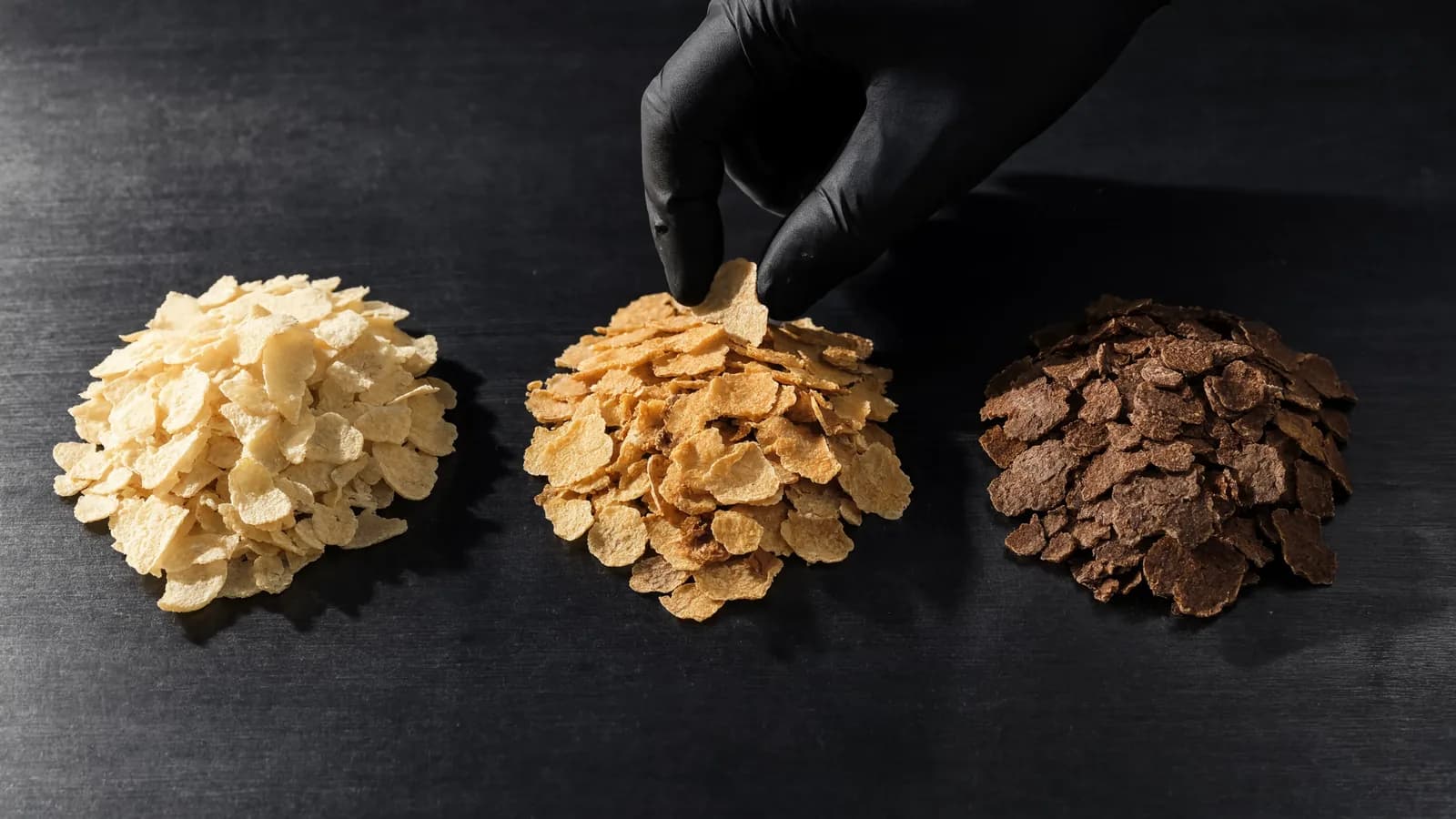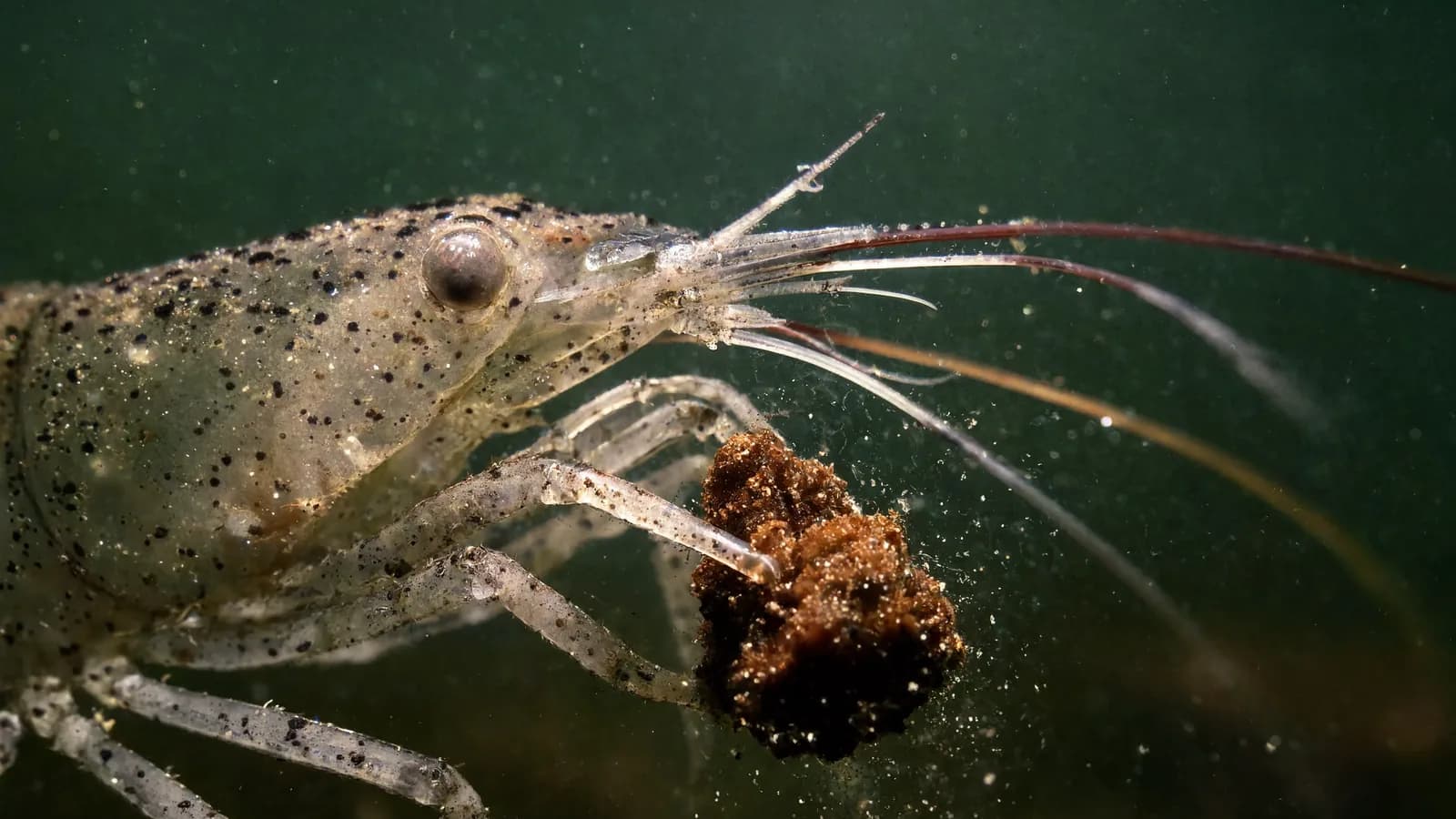
A fish sees a pellet, opens its mouth, and the pellet is gone. The whole transaction takes a fraction of a second, and whatever was in that pellet is now inside the fish. A shrimp does nothing of the sort. It finds the pellet by smell, grasps it with its appendages, holds it under its body, and grinds pieces off the outside with its mouthparts — slowly, untidily, dropping fragments the entire time. One pellet can occupy a shrimp for many minutes. During every one of those minutes, the pellet is sitting in water.
That single biological fact is the whole article. It is why water stability is the defining specification of shrimp feed rather than a line item on a datasheet, and it is why a pellet engineered for a fish — a pellet that only ever needed to survive a second of contact — falls apart in a shrimp pond and takes your margin with it. Everything below follows from how shrimp eat.
Why a shrimp is not a small fish
Start with the mouth. A shrimp has no jaw that closes on a pellet; it has mandibles and a set of appendages that manipulate food externally. It is a grazer working on a lump it holds in front of itself. It is also a nocturnal, bottom-oriented feeder in a pond full of competitors, which means the pellet has to still be there — and still be recognisable as food — some time after it lands.
Now add the second difference: shrimp feed is slow-sinking by design, not floating. You cannot watch a shrimp pond the way you watch a tilapia cage and read the feeding response off the surface. The feed goes down to where the animal lives, and it stays there, out of sight, doing either its job or its damage. In a fish cage you find out you overfed within minutes. In a shrimp pond you find out weeks later, at the bottom, in the sludge.
What leaches first — and why it is the expensive part
Here is the point most discussions of stability miss entirely. A disintegrating pellet does not lose its nutrients evenly, like a brick crumbling into identical dust. It loses them in order of solubility. The water-soluble fraction goes first: the vitamins, the attractants, the free amino acids, the fine soluble protein. The insoluble structural material — starch, fibre, ash — stays behind longest.
Read that again, because it reframes the loss. A poorly stable pellet is not merely "less feed". It is feed whose most valuable and most expensive fraction has already left, delivered straight into the water the shrimp has to live in. What the shrimp eventually eats is the nutritionally stripped remnant — the cheap structural leftovers of a pellet you paid a premium price for. And what leached out has not vanished; it is now dissolved organic load in your pond, and you will pay to deal with it. You paid for the nutrient, you did not feed the nutrient, and now you are paying again to aerate away the consequences. Paid twice.
| Fraction | How fast it leaves | What it costs you |
|---|---|---|
| Attractants & free amino acids | Fastest — minutes | The pellet stops smelling like food before the shrimp finds it. Self-defeating: you paid to attract, and the attraction dissolved. |
| Water-soluble vitamins | Fast | The most expensive kilogram in the formula, fed to the water. Nothing on the shrimp's side records it. |
| Fine soluble protein | Moderate | Your CP on paper stops matching the CP in the animal. Dissolved nitrogen loads the pond. |
| Fines & broken particles | Immediate on contact | Never eaten at all. Straight to the bottom as organic load and sludge. |
| Starch, fibre, ash | Slowest — stays | This is what the shrimp actually eats when stability fails. The cheap part. |
The ≥ 2 hour benchmark: what it means and what it does not
Our shrimp grower feed carries a water stability specification of ≥ 2 hours. That figure is useful and it is honest, and I want to be precise about what it is. It is a result from a standardised laboratory test under defined conditions. It is not a promise about your pond.
Salinity changes how a binder behaves. Temperature changes the rate of everything. Agitation — aerator wash, current, the shrimp's own handling — is mechanical work applied to the pellet that no still beaker reproduces. Two feeds that both test at two hours in a lab can behave visibly differently on a tray in a high-salinity Gulf pond at 32 °C with paddlewheels running. The lab number ranks feeds. It does not predict ponds.
So ask the question that separates a specification from a marketing number: which method, and under which conditions? Test duration, water temperature, salinity, whether the sample was agitated or static, whether the endpoint was dry matter retained or visual disintegration. A stability figure with no stated method is not a specification — it is a claim. This is the same discipline as reading a COA, where the method behind the number matters as much as the number, and for exactly the same reason: without the method, two figures cannot be compared, so neither one means anything.
What actually creates stability — and what it costs
Stability is not one thing you add. It is the sum of a formulation decision and half a dozen process decisions, and every one of them has a price.
Binders
The obvious lever, and the one most often over-pulled. Binders hold the matrix together against water. They also occupy formula space that could have carried nutrition, and past a certain point they physically shield nutrients from the shrimp's own digestive enzymes. A pellet bound hard enough to be indestructible is a pellet the animal cannot fully digest.
Starch gelatinisation, conditioning and extrusion
Steam conditioning plus mechanical energy gelatinises starch, and gelatinised starch is the cheapest binder you own — it is already in the formula. Extrusion applies far more heat, pressure and shear than steam pelleting and generally produces a more stable, more uniform particle. It also costs more per tonne, and the same energy that gelatinises starch can degrade heat-sensitive vitamins. Steam pelleting is not wrong for shrimp; it simply has to be run properly — good conditioning time, correct moisture, adequate retention — rather than run fast.
Grind fineness, die and cooling
Fine, uniform grinding is unglamorous and it does more for stability than most additives. Coarse particles are fracture points — a pellet breaks where its structure is discontinuous. Die geometry, particularly the compression ratio, decides how much work goes into the pellet on its way out. And cooling is where stability is quietly lost: pull the heat and moisture out too fast and you crack the pellet's surface, and you have just built the fissures that water will exploit two hours later.
Attractants: why they matter more here than in fish
A shrimp locates food chemically. It does not see the pellet across the pond; it detects a dissolved plume and works toward it. That is the whole search mechanism, and it means palatability in shrimp is not a nice-to-have layered on top of nutrition — it is the step before nutrition happens at all.
Three things compound it. Feeding is slow, so the pellet must stay attractive over a long window, not a moment. Feeding is competitive — a pond is full of animals and the pellet that is not found quickly is found by something else or by nothing at all. And feeding is intermittent: a shrimp that has just moulted eats little or nothing, so the feed sitting in the pond has to hold its identity as food while the population is not interested in it.
Now put that next to the leaching table above and you see the trap. Attractants are among the first things to dissolve out of a pellet. So a feed with weak water stability is self-defeating in the most literal way available: it stops smelling like food before the shrimp has found it. You did not just lose the attractant — you lost it in a way that guarantees the rest of the pellet goes uneaten too. This is why stability and palatability are one problem and not two, and why a feed should be judged on both together or on neither.
Feeding trays: the cheapest instrument on the farm
You cannot see the bottom of your pond. The feeding tray — the lift net — is the only window you have, and it is the single best investment a shrimp farm can make. Not the feed brand. Not the aerator upgrade. The tray, and the discipline to read it every time. A farm running an ordinary feed with real tray discipline will beat a farm running a premium feed by the bag chart, and it will beat it consistently.
The logic is simple. A feeding chart is a prediction made by someone who has never seen your pond. The tray is a measurement made in it. When the two disagree, the tray is right.
- Set trays properly. Several per pond, away from aerator wash and away from the bank, at a consistent depth. A tray in a bad position measures the position, not the pond.
- Load a known, fixed proportion of the meal onto the tray. Unknown loading makes the reading uninterpretable — you are guessing at a number you could simply have weighed.
- Check at a fixed interval after feeding and hold to it. The interval is your control; if it drifts, today's reading cannot be compared with yesterday's, and comparison is the entire point.
- Adjust the next ration on what you saw. Tray clean and early: the pond wants more. Feed left: cut, and cut without arguing with yourself about the chart.
- Read the feed itself, not only the quantity. Are the pellets intact or are they mush? A tray of disintegrated remnant at the check interval is a stability problem, and no ration adjustment fixes it.
Feed more often in smaller amounts. A shrimp is a slow, near-continuous grazer with a short gut and a fast transit time; it is not built to handle a large discrete meal. Multiple small feedings track that biology and keep less feed sitting in the water per event, which means less leaching per event. Feeding frequency is a stability strategy that costs you nothing but labour.
Moulting, and the special case
Shrimp stop feeding around moulting. This is normal biology, not a problem to be solved, and the mistake is to read a full tray during a moult as a reason to worry — or worse, to keep feeding the chart anyway. When a population moults in loose synchrony, intake drops across the pond, and feed put in during that window is feed put straight into the sediment. Watch the population, cut back through the moult, and come back up as the trays clear again.
Nursery versus grow-out
Particle size has to match the animal, and this is where crumble earns its place. Post-larvae and nursery-stage shrimp cannot handle a grow-out pellet — they physically cannot manipulate it — so crumbles are fed early and pellets take over as the animal grows. Note the stability wrinkle: a crumble is a broken pellet by definition, with far more cut surface exposed per unit of feed, so it leaches faster than the pellet it came from. Small animals, high water exposure, expensive feed. Nursery feeding demands more discipline, not less.
The loop: uneaten feed comes back for you
People present water quality as a checklist. It is not a checklist. It is a loop, and the loop is what makes poor stability so much more expensive than the wasted feed alone.
Uneaten feed and leached nutrients become organic load. Organic load settles as sludge on the pond bottom — exactly where the shrimp lives. Sludge is fuel for bacterial decomposition, and decomposition consumes oxygen, so biological oxygen demand climbs. Dissolved oxygen falls. And a shrimp in low DO does two things: it stops eating, and it converts what it does eat far less efficiently. So intake drops and FCR worsens. Now the feed you are still putting in is even less likely to be eaten — which means more uneaten feed, more organic load, more sludge, more oxygen demand. The loop has closed, and it is now feeding itself. The pond is degrading and your feed bill is going up at the same time. That is the mechanism people mean when they say a pond "crashed", and it almost never starts with a dramatic event. It starts with a feed that fell apart, and a tray nobody read.
Now add the Gulf. Warm water holds less dissolved oxygen than cool water — that is physics, not husbandry — and our ponds are warm for most of the year. High salinity lowers the saturation ceiling further. So a Gulf pond starts the day with less oxygen headroom than a temperate one, and metabolic and bacterial demand at those temperatures is higher. The loop does not behave differently here. It just closes faster, and it forgives less. A margin of error that a cooler operation can absorb over a week can disappear here overnight. Managing feed input is preventive husbandry in the plainest sense: keeping the organic load down is how you keep the water fit to live in.
The Gulf: why this is harder here
Shrimp farming in the GCC is not a curiosity. Saudi Arabia operates the region's most developed sector by a wide margin, with activity in the UAE and Oman alongside it, and it sits inside a broader food-security push that has put real capital behind domestic protein production. That investment is why the operational detail in this article is worth money rather than being an academic exercise.
But the conditions are their own thing. High salinity, high water temperature and a low dissolved oxygen saturation ceiling are the baseline here, not an exception, and they compress every margin described above: the leaching window, the oxygen buffer, the recovery time after a mistake. A Gulf shrimp farm has less room for a mediocre pellet than almost anywhere else. The conditions do not create new problems. They shorten the time you have to notice the old ones.
Storage: the stability problem you build yourself
A feed that left the mill at two hours of stability does not necessarily arrive at your pond that way. Between the mill and the tray sits a Gulf warehouse, and it is not a neutral space.
- Moisture pickup attacks the binder. Humid air is water arriving slowly. A pellet that has taken up ambient moisture in an un-airconditioned shed has already begun the process the pond was going to start — its structural integrity is partly spent before it ever gets wet. Pallets off the floor, away from walls, and out of the doorway airflow.
- Fines are a stability problem you created. Every rough handling, every drop, every extra transfer shears the pellet surface and generates fines. Fines are the fraction that never gets eaten — it goes to the bottom on contact. If your trays show fines and your COA says the feed is stable, look at your own forklift before you blame the mill.
- Heat oxidises fat. Shrimp feed carries lipid, and lipid in a 45 °C shed oxidises. Rancid fat is a palatability problem before it is anything else, and palatability is the step before nutrition. The shrimp does not need to know why the pellet smells wrong.
- Rotate genuinely, not nominally. First in, first out, enforced physically by how the stack is built — not by a note on a clipboard. In this climate, old stock at the back of the shed is not old stock; it is a different product from the one you bought.
Which brings up buying strategy. The GCC imports most of its aqua feed and its feed ingredients, lead times are long, and the temptation is to hedge by buying six months of cover. In Gulf heat that is a false economy. You have not secured your supply; you have moved your stability problem from the supplier's climate-controlled mill into your own shed and given it half a year to work. Buy to a realistic horizon, hold a genuine safety stock rather than a speculative one, and treat regional stock and shorter lead times as worth paying for. Documentation follows the same rule — health certificates, origin declarations and the contaminant panel have to match the destination authority's current requirements, MOCCAE in the UAE and the relevant national authority elsewhere in the GCC, and that is decided before the container sails, not after it lands at Jebel Ali.
Protein, fishmeal reduction, and the point everyone forgets
Our shrimp grower feed specifies crude protein at 35–40%, which is where a grow-out shrimp diet belongs. Historically a large share of that protein came from fishmeal, and fishmeal is expensive, volatile in supply, and something every operation in this region is trying to depend on less. Two credible partial substitutes are worth discussing honestly.
Fermented soybean meal is one. Trial work generally supports replacing on the order of 10–20% of fishmeal protein, and the reason it works better than raw soy is that fermentation addresses the anti-nutritional factors limiting how much plant protein a shrimp tolerates. Reformulate on digestible amino acids, never tonne-for-tonne on crude protein. Milled black soldier fly larvae is the other, with inclusion in shrimp feed in the range of 20–75 kg/t, and the same caveat applies with force: reformulate energy, digestible amino acids and Ca:P, and work from the batch COA, because BSFL composition varies markedly with rearing substrate and processing.
And here is the point almost nobody makes, which is the reason this section is in this article at all. A formulation change is also a stability change. Ingredients are not interchangeable nutritional abstractions — they are physical materials with their own particle characteristics, starch, oil and binding behaviour, and they behave differently through a conditioner and a die. Pull fishmeal out and put FSBM or BSFL meal in and you have altered the matrix that holds your pellet together. The pellet may bind better. It may bind worse. It may bind the same and behave differently at 40 ppt salinity. You do not know, and you cannot reason your way to the answer from the nutrient matrix.
So re-verify. Run the water stability test again on the new formulation, by the same method and under the same conditions as the old one, before the feed goes near a pond. Do not assume the spec carried over — it is a property of a recipe and a process, not a badge attached to the product name. A cheaper protein that quietly cost you thirty minutes of stability is not a saving. It is the most expensive kind of loss, because it does not appear on any invoice.
Frequently asked questions
Can I feed fish pellets to shrimp if the protein level matches?
Matching crude protein does not make a fish pellet a shrimp feed. A fish swallows a pellet whole in under a second, so fish feed was never engineered to survive prolonged immersion. A shrimp grasps the pellet and nibbles it externally for minutes. A fish pellet in a shrimp pond leaches its vitamins and attractants into the water first, leaving a nutritionally stripped remnant, and the difference does not appear on either datasheet.
Does ≥ 2 hours water stability mean the pellet lasts two hours in my pond?
No. It is a standardised laboratory result under defined conditions, which makes it useful for ranking feeds against each other. Your pond has its own salinity, temperature and agitation from aerators and current, and all three change real behaviour. Treat the figure as a comparative benchmark, ask which method and conditions produced it, and let your feeding trays tell you what is actually happening at the bottom.
Is more water stability always better?
No, and this is the point most feed marketing avoids. Stability comes from binders and processing, and over-binding shields nutrients from the shrimp's digestive enzymes, reducing digestibility. Excessive hardness can also reduce intake. The goal is adequate stability with good palatability — stable enough to survive the feeding event intact, not so armoured that the animal cannot efficiently use what it eats.
If I replace some fishmeal with FSBM or BSFL, does the stability spec still hold?
Do not assume it does. Water stability is a property of a specific recipe run through a specific process, not a badge attached to the product name. Ingredients differ in particle characteristics, starch, oil and binding behaviour, so swapping one changes the matrix holding the pellet together. Re-test stability on the new formulation using the same method and conditions before the feed reaches a pond.
What is shrimp feed actually made of?
The protein base is typically fishmeal plus plant meals such as soybean — increasingly fermented soybean meal or insect meal in modern formulations — carried on wheat flour and the binders that give the pellet its water stability. Around that sit marine attractants, because shrimp find feed by smell, and the mineral–vitamin package that supports moulting: calcium, phosphorus, cholesterol, carotenoids. The list matters less than the process — the same formula, poorly conditioned and pressed, falls apart in an hour.
The bottom line
Water stability is the specification that decides whether the rest of your feed sheet means anything, because a pellet that disintegrates early does not deliver a slightly weaker version of its formula — it delivers the cheap half and dumps the expensive half in your water. Buy on a stability figure with a stated method, not on a number alone. Do not chase maximum stability; adequate stability with real palatability beats an armoured pellet the shrimp cannot digest. Re-verify whenever you touch the formulation. And then take the position this whole article has been building toward: tray discipline beats the feed brand. A good feed read badly loses to an ordinary feed read well, every season, in every pond. Buy the better pellet — then go and pull the trays.
Sourcing this, or trialling it?
We trade animal and bird nutrition from Dubai, in direct contact with the manufacturers behind every product, with a certificate of analysis on every batch. Tell us the specification you need and we will tell you honestly whether we are the right supplier for it.