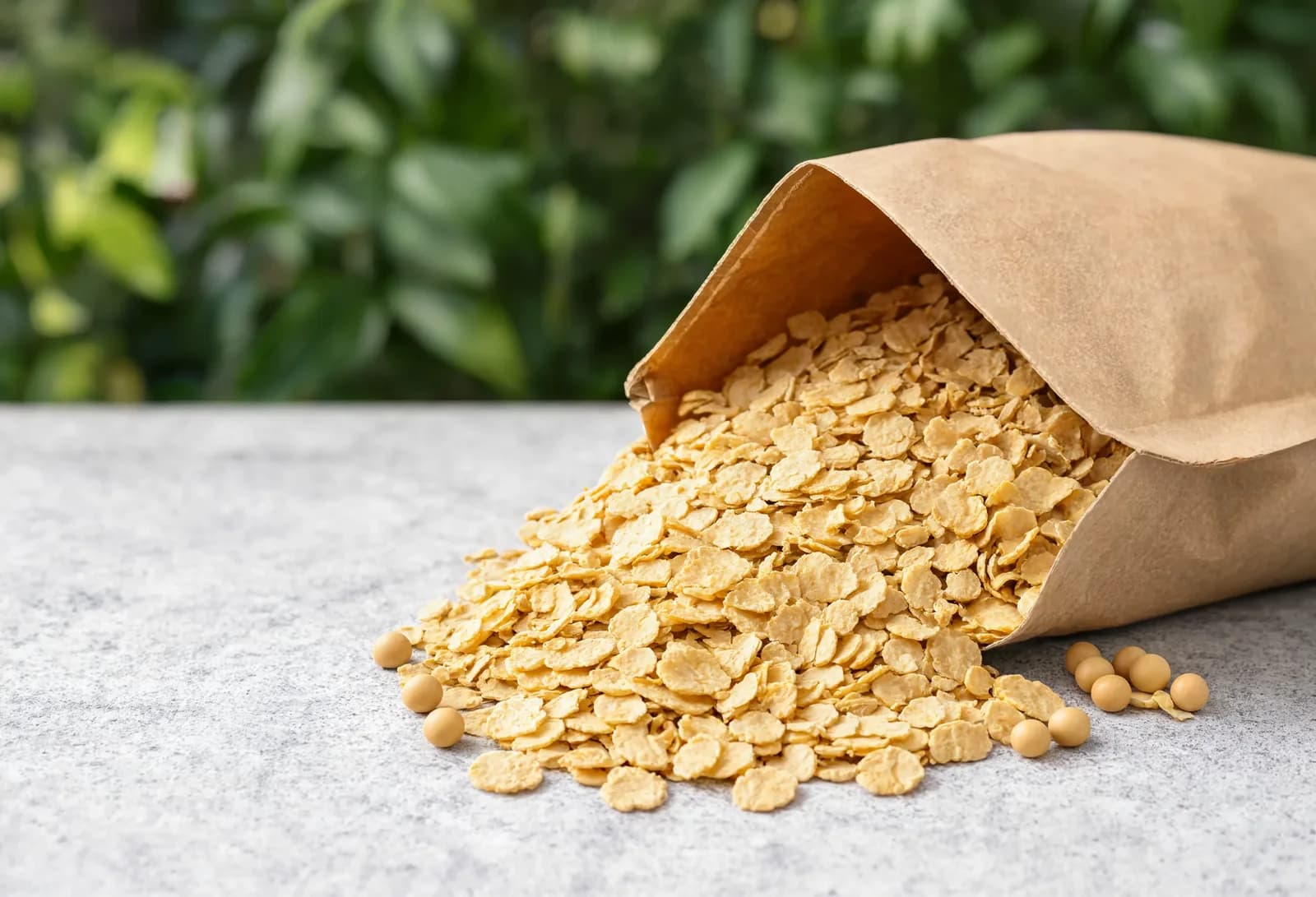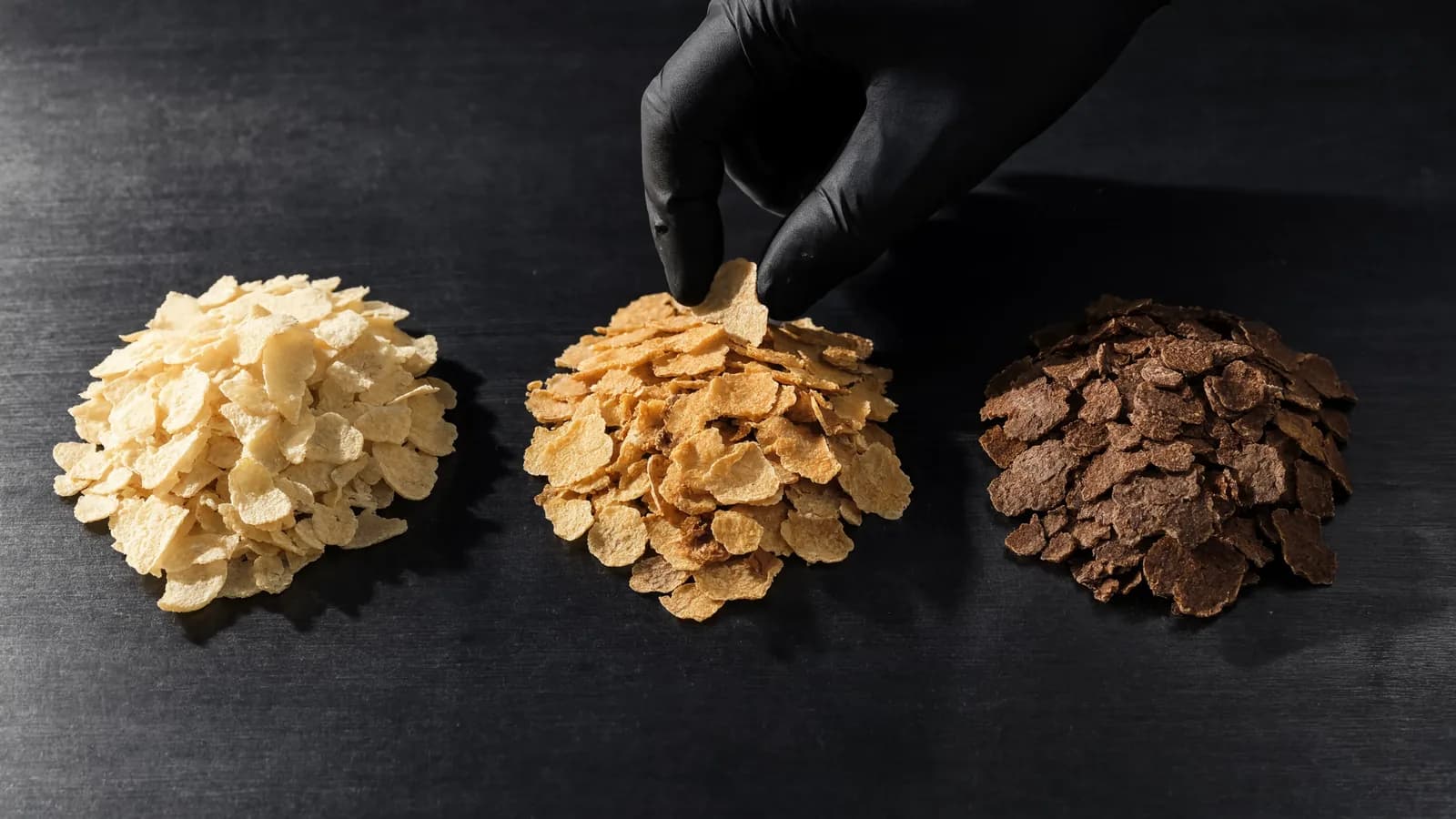
Here is a test. Two suppliers offer you flaked full-fat soybean. Both datasheets say roughly 36% crude protein and roughly 18% fat. The prices differ by a margin that looks like a negotiating position rather than a quality gap. Which one do you buy?
The honest answer is that you cannot tell, and neither datasheet has given you the information you would need. Crude protein and fat describe what went into the machine. They say nothing about what the machine did. With full-fat soybean, what the machine did is the entire product. Two flakes with identical proximate analysis can differ by a wide margin in the protein an animal actually absorbs — and one of them can make birds grow worse than if you had fed no soy at all. This article is about the gap between those two bags, and how to read it.
The process window is narrow, and both walls hurt
A raw soybean is not food. It is a seed that has spent a long evolutionary career making itself unpleasant to eat, and it is well armed. The relevant weapon here is trypsin inhibitor: a protein that binds and disables trypsin, the enzyme the animal secretes specifically to digest protein. Feed raw soy and you are feeding an ingredient that actively obstructs the digestion of itself and of everything around it. The animal responds by secreting more enzyme, the pancreas works harder, and growth falls. Lectins and other heat-labile factors ride along.
Heat is the answer. Trypsin inhibitor is a protein, and proteins denature. Flake the bean to open it up, apply controlled heat with controlled moisture for a controlled time, and the inhibitor comes down to a level the animal can live with. Note the phrasing. It comes down; it does not go to zero, and a supplier who tells you it does is either testing badly or selling badly. Correct processing reduces heat-labile antinutritional factors to controlled levels rather than eliminating them. That is the honest description, and it is the one on our own product page.
The other wall: too much heat
If heat fixes the problem, more heat fixes it better. This is wrong, and it is the mistake that costs more money, because it is invisible. Push the treatment too far and you start damaging the protein you paid for. Lysine is the first casualty — its free amino group reacts with reducing sugars and the resulting complex is, from the animal's point of view, no longer lysine. The crude protein assay still counts the nitrogen. The bird cannot use it. Overall protein digestibility falls with it.
So you have two walls. Underprocess and the trypsin inhibitor obstructs digestion. Overprocess and you destroy the lysine that is the reason you bought a soy product in the first place. Between them sits a window — narrower than most buyers assume, and one that shifts with bean moisture, batch, and how the plant was running that morning. Full-fat soybean is not a commodity you buy on a proximate analysis. It is a process you buy on evidence.
TIA and protein solubility: why neither works alone
This is the section that matters. If you read nothing else, read this. There are two indicators of heat treatment in routine use, they point in opposite directions, and each is blind to exactly the failure the other catches. Reading one alone is not half a quality check. It is a way of being confidently wrong.
Trypsin inhibitor activity — the underprocessing detector
TIA measures the residual inhibitor directly. High TIA means heat treatment did not go far enough, full stop. It is the most direct read on the underprocessing wall you can buy. Urease activity is often used as a cheap, fast proxy for the same thing — the urease enzyme is denatured on a similar heat curve, so if urease is still active the beans are undercooked. Urease is a screening tool, not a measurement; it is useful on the line and weak on a COA.
Now the trap. TIA cannot detect overprocessing. Take a properly cooked batch and cook it for another twenty minutes: TIA goes lower. It looks better. The number moves in the direction you were hoping for while the lysine burns. A low TIA is consistent with a perfect batch and equally consistent with a ruined one. On its own it is not evidence of quality — it is evidence of heat, and heat is not the same thing.
Protein solubility — the overprocessing detector
Protein solubility in potassium hydroxide — KOH solubility — measures how much of the protein still dissolves. Heat denatures protein, and denatured protein dissolves less. So solubility falls as heat rises, and a low solubility says the protein has been cooked hard. It is the direct read on the overprocessing wall, and it is the check that catches the expensive, invisible failure.
And now the mirror trap. Solubility cannot detect underprocessing. Raw soybean has excellent protein solubility — the protein is undenatured, so of course it dissolves. A raw, dangerous, trypsin-inhibitor-loaded bean scores beautifully on solubility. High solubility is consistent with a perfectly treated batch and equally consistent with one that was barely heated at all.
Put them side by side and the logic closes. TIA is blind above the window; solubility is blind below it. Only the pair brackets the window from both sides, and only the pair can tell you that a batch sits inside it. This is not a nutritionist's fussiness — it is arithmetic. One number leaves half the failure modes unmeasured, and you do not get to choose which half your supplier had a bad day on.
| Batch condition | TIA reads | Protein solubility reads | What it costs you |
|---|---|---|---|
| Underprocessed | High — caught | High — looks excellent, misses it entirely | Obstructed digestion, pancreatic strain, depressed growth |
| Correctly processed | Low | Moderate — reduced but not collapsed | Nothing — this is the window |
| Overprocessed | Low — looks excellent, misses it entirely | Low — caught | Damaged lysine, lower protein digestibility, silent loss |
Look at the diagonal. In two of the three rows, one indicator is actively reassuring you while the batch is defective. That is worse than no information, because no information makes you cautious and a good-looking number makes you confident. Ask for both, per batch, and read them as one statement.
One ingredient doing two jobs — and the recalculation it forces
The reason anyone bothers with full-fat soybean is that the oil never left. Solvent extraction pulls the oil out of the bean to sell separately, and the meal that remains is a protein ingredient. Flake the whole bean instead and you have amino acids and concentrated energy arriving in the same flake, in the matrix the plant built. In a market where you are buying soybean meal from one origin and oil from another and paying freight on both into Jebel Ali, consolidating them has an obvious appeal.
The appeal is real. The arithmetic behind it is where people get careless. Full-fat soybean can replace defined portions of soybean meal plus added oil — and that sentence has a condition attached that is not decorative. It replaces them only after the complete diet is recalculated on digestible amino acids, metabolizable energy and total fat. All three. Not one, not two.
Why a tonne-for-tonne swap fails
Pull soybean meal out and put full-fat soybean in at the same weight and you have changed three things at once. Protein per tonne drops, because the oil is occupying space the protein used to have. Energy per tonne rises, because that oil is the densest energy in the shed. Total dietary fat rises, and it rises whether or not you remembered to take the added oil back out. Balance on crude protein alone and the energy runs away from you. Balance on energy alone and the amino acids fall short. Balance on both and forget total fat and you walk into the problems in the next section.
And digestible amino acids, not crude protein — for the reason the whole article turns on. Crude protein counts nitrogen. If the batch was overprocessed, some of that nitrogen is lysine the animal will never see, and your formulation software will keep counting it because the assay does. This is precisely where a heat-damaged batch does its damage: not on the invoice, but in a spreadsheet cell that says the diet is adequate when it is not.
High unsaturated fat is not an unlimited benefit
Suppliers of this ingredient like to talk about the fat as though it were pure upside. It is not, and there are three separate reasons why — one chemical, two biological. They apply to different customers, so find yours.
It oxidises, and the Gulf helps it
Soybean oil is highly unsaturated. Unsaturated means double bonds, and double bonds are where oxygen attacks. Rancidity is not a cosmetic problem: oxidation degrades the energy you bought, destroys fat-soluble vitamins in the mix, produces compounds animals refuse to eat, and shows up first as an unexplained drop in intake that nobody connects to the soy. Heat accelerates it. So does humidity, so does light, so does trace metal contamination, so does a bag sitting on a warehouse floor.
This is the point where full-fat soybean is genuinely more fragile than soybean meal, and it deserves to be said plainly. SBM has had most of its oil removed — there is far less there to go rancid, and it forgives a mediocre warehouse. Full-fat does not forgive. If your storage is a shed in Sharjah in August with no climate control, you are running a slow oxidation reactor and the ingredient you are running it on is the one that minds most. Peroxide value on the COA tells you where the batch started. It does not tell you where your warehouse will take it.
The rumen has a fat ceiling
A rumen is a fermentation vat run by microbes, and those microbes do not tolerate much fat. Push total dietary fat too high and fibre digestion falls, intake follows it down, and you have paid for energy that removed energy. This is why the guidance on our own spec table for dairy is a per-head daily allowance rather than a percentage of the ration, and why it carries the instruction to keep total dietary fat within nutritionist limits. That caveat is doing real work — it is not legal padding.
Milk fat depression
The specific version of that problem for a dairy buyer. Unsaturated fat entering the rumen gets biohydrogenated, and when the rumen environment is not right — low fibre, low pH, too much unsaturated oil arriving at once — that pathway produces intermediates that suppress milk fat synthesis in the udder. The cow keeps giving milk. The milk gives less fat. If you are paid on components, you have engineered a pay cut and you will find it on the tanker report, not in the feed shed. Full-fat soybean is a legitimate dairy ingredient — it is on our spec table for exactly that use — but it is one that has to be introduced by someone watching the fat test.
Inclusion by species: no single rate carries across
The figures below are the trial inclusion ranges from our own product spec table. Read them as starting points for a trial, not as a specification and not as a guarantee. They exist because the species differ so much that a number borrowed from the wrong row is worse than no number at all — a rate that is routine in a broiler grower is not a rate you hand to a lactating cow.
| Animal / diet | Trial inclusion | What governs the ceiling |
|---|---|---|
| Dairy (lactating) | 1.0–2.5 kg/head/day | Total dietary fat, rumen function, the milk fat test |
| Calf starter | 50–120 kg/t | Pre-weaned calves are functionally monogastric — TIA matters most here |
| Sheep & goat | 50–150 kg/t | Same rumen fat limits, wide range because diets vary widely |
| Broiler starter | 50–100 kg/t | Immature gut — the least tolerant bird you will feed it to |
| Broiler grower & finisher | 80–180 kg/t | The widest window — a developed gut and a real appetite for energy |
| Layers | 50–150 kg/t | Energy balance; oxidised fat reaches the egg before it reaches your report |
| Fish | 30–100 kg/t | Selected species only — the narrowest range on the table, and deliberately so |
Notice how much the ranges move. A broiler finisher tolerates roughly double what a starter does, because the difference between those two birds is the gut. And notice the fish row is the tightest, because "selected aquaculture diets" means what it says — this is not a general-purpose aqua protein and it should not be treated as one. Every one of these numbers assumes the diet was reformulated, not just amended.
Storing it in the Gulf, and what to demand on the COA
The UAE, Saudi Arabia, Oman, Kuwait, Qatar and Bahrain import essentially all of their feed protein, which means every batch you handle has already spent weeks in a container before you see it. For most ingredients that is a logistics fact. For a high-unsaturated-fat ingredient it is the start of the clock. Buy on the peroxide value at delivery rather than at origin, ask what the container's transit conditions were, and understand that a summer between Jebel Ali and your mixer is not neutral time.
Practically: buy in quantities you will actually turn over, not the quantities that win the best price per tonne. Store cool, dark and dry, on pallets, away from walls. Rotate genuinely. And retest an old batch rather than trusting the certificate it arrived with — the certificate was true in the month it was issued and says nothing about what your shed has done to the oil since.
The COA items to demand
- Trypsin inhibitor activity. The underprocessing check. Ask which method was used and hold the supplier to the same one every batch — TIA figures from different methods are not comparable, and a supplier who switches methods between shipments has given you two unrelated numbers.
- Protein solubility — KOH solubility, and urease activity if they run it. The overprocessing check, and the one most often missing. If a supplier offers you TIA and nothing else, they are showing you the wall they did not hit.
- Oil oxidation status — peroxide value at minimum, dated. Undated is useless. A peroxide value with no date attached is a number about a moment nobody has identified.
- Crude protein, fat and moisture. Necessary, and nowhere near sufficient — that is the premise of this entire article. Moisture in particular governs both storage life and how the batch behaved in the processor.
- Microbial panel and mycotoxins. Aflatoxin B1 is a hard limit at GCC import inspection rather than a nice-to-have. Requirements differ between GCC states and are revised periodically — confirm the current requirement with MOCCAE in the UAE, or the relevant national authority for your destination, per shipment.
Frequently asked questions
Can I judge flaked full-fat soybean from crude protein and fat?
No, and this is the central point. Crude protein and fat describe the bean that entered the process, not what the process did to it. An underprocessed batch with excessive trypsin inhibitor activity and an overprocessed batch with heat-damaged lysine can both show an identical proximate analysis. You need trypsin inhibitor activity and protein solubility, measured per batch, to know which one you have.
Why do I need both TIA and protein solubility? Is one not enough?
Each is blind to the failure the other catches. TIA detects underprocessing but falls further as you overcook, so a low TIA can hide burnt lysine. Protein solubility detects overprocessing but is high in raw beans, so a high solubility can hide a barely heated batch. Only the pair brackets the process window from both sides. One number alone leaves half the failure modes unmeasured.
Can it replace soybean meal and oil one-for-one in my ration?
Not by weight. It replaces defined portions of soybean meal plus added oil only after the complete diet is recalculated on digestible amino acids, metabolizable energy and total fat. A same-weight swap lowers protein per tonne, raises energy, and raises total dietary fat all at once. Balance on crude protein and the energy drifts; balance on energy and the amino acids fall short.
Does it store as well as soybean meal in a Gulf warehouse?
No — it is meaningfully more fragile, and you should plan for that. Soybean meal has had most of its oil removed; full-fat soybean keeps a high level of unsaturated oil, which oxidises. Gulf summer heat and humidity accelerate it. Buy quantities you will turn over, store cool, dark and dry on pallets, and retest older stock rather than trusting the arrival certificate.
The bottom line
Flaked full-fat soybean is a good ingredient sold badly. The trade quotes it on crude protein and fat, which is the one basis on which a ruined batch and an excellent batch are indistinguishable. Take a position on this: a full-fat soy offer without trypsin inhibitor activity and protein solubility on the batch COA is not a cheaper offer, it is an unpriced one, and you should treat the discount as what it usually is — the cost of the tests nobody ran.
Buy it where it earns its place: a diet that genuinely needs both amino acids and energy, recalculated properly, with total fat inside the limits your species will tolerate. Store it like the perishable it is, not like the meal it resembles. Do that and it is one of the more efficient ways to move protein and energy into an animal in this region. Skip the two numbers and you are not buying full-fat soybean — you are buying a bag of beans that met a heater, and you have no idea what happened next.
Sourcing this, or trialling it?
We trade animal and bird nutrition from Dubai, in direct contact with the manufacturers behind every product, with a certificate of analysis on every batch. Tell us the specification you need and we will tell you honestly whether we are the right supplier for it.